Consider a cyclic quadrilateral. Without drawing its circumcircle, how can we find out whether the centre Class 9
Consider a cyclic quadrilateral. Without drawing its circumcircle, how can we find out whether the centre Class 9
Question 1.
Consider a cyclic quadrilateral. Without drawing its circumcircle, how can we find out whether the centre of the circumcircle lies inside the quadrilateral or outside? What is the best way of finding out? Class 9
Solution:
There are 3 possible cases in a cyclic quadrilateral:
i. If the quadrilateral is acute angled, the circumcentre lies inside.
ii. If the quadrilateral has an obtuse angle, the circumcentre lies outside the quadrilateral.
iii. If the quadrilateral is a rectangle (all angles 90°), the circumcentre lies at the intersection of the diagonals, i.e., inside the quadrilateral.
Question 2.
When two chords intersect, each of them is divided into two line segments. Show that if the intersecting chords are of equal length, then the line segments of one chord are equal to the corresponding line segments of the other chord. Class 9
Solution:
Given: AB and CD are two chords of a circle intersecting at E, and AB = CD.
To Show: BE = CE, and AE = DE Construction: Draw OM ⊥ AB, and ON ⊥ CD.
Join OE.
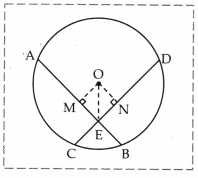
Proof:
AB = CD
∴ OM = ON ...[Equal chords of a circle are equidistant from the centre]
In ∆OME and ∆ONE,
OM = ON
∠OME = ∠ONE = 90° ... [By construction]
OE = OE ... [Common side]
∴ ∆OME ≅ ∆ONE ... [By RHS congruence]
∴ ME = NE
...(i) [Corresponding parts of congruent triangles]
Now, AB = CD ... [Given]
∴ $\frac{1}{2}$AB = $\frac{1}{2}$CD ... [Multiplying both sides by $\frac{1}{2}$]
∴ AM = DN ...(ii)[Perpendicular from the centre of the circle bisects the chord]
Now, AM + ME = DN + NE
... [Adding (i) and (ii)]
∴ AE = DE ...(iii)
Now, we have AB = CD
∴ AB - AE = CD - DE
... [Subtracting AE from both sides and applying (iii)]
∴ BE = CE