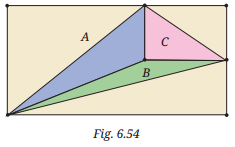
In Fig. 6.54, we see three triangles within a rectangle. The areas of the triangles are A, B, C, as marked. Class 9
In Fig. 6.54, we see three triangles within a rectangle. The areas of the triangles are A, B, C, as marked. Class 9
Question 1.
In Fig. 6.54, we see three triangles within a rectangle. The areas of the triangles are A, B, C, as marked. Show that the area of the rectangle is $\frac{2(A+C)(B+C)}{C}$ Class 9
Solution:
Given:
Three triangles inside a rectangle with areas A, B, C
To prove:
Area of rectangle = $\frac{2(A+C)(B+C)}{C}$
Proof:
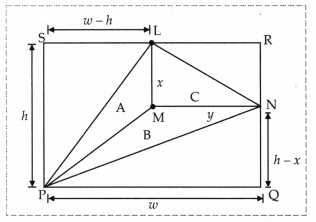
Let PQRS be a quadrilateral and A, B and C are regions represented by ∆PML, ∆PMN and ∆LMN respectively.
Let w be base and h be height of rectangle PQRS.
∴ PQ = SR = w and SP = QR = h
Let ∆LMN (Region C) has base MN = y and height RN = x
Using Area of triangle = $\frac{1}{2}$ × base × height
∴ A = Area of ∆PML = $\frac{1}{2}$ × x ×(w - y) ... (i)
∴ B = Area of ∆PMN = $\frac{1}{2}$ × y × (h - x) ...(ii)
∴ C = Area of ∆LMN = $\frac{1}{2}$ × x × y ...(iii)
Now,
Adding (i), (ii) we get
A + C = $\frac{1}{2}$ × x × (w - y) + $\frac{1}{2}$ × x × y
= $\frac{1}{2}$ (wx -xy + xy)
A + C = $\frac{1}{2}$wx ........(iv)
Adding (ii) and (iii), we get
B + C = $\frac{1}{2}$ × y × (h - x) + $\frac{1}{2}$ xy
= $\frac{1}{2}$ (yh - xy + xy)
B + C = $\frac{1}{2}$ × yh ...(v)
$\begin{aligned} \text { R.H.S. } & =\frac{2(A+C)(B+C)}{C} \\ & =\frac{2 \times \frac{1}{2} w x \times \frac{1}{2} y h}{\frac{1}{2} x y}\end{aligned}$
...[From (iii), (iv) and (v)]
= w × h
= Area of rectangle PQRS
= L.H.S.
∴ Area of rectangle = $\frac{2(A+C)(B+C)}{C}$
[Note: Question has been modified,]