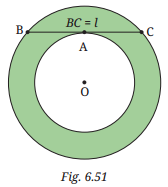
In Fig. 6.51 we see two concentric circles with a common centre O. A chord BC of the larger circle Class 9
In Fig. 6.51 we see two concentric circles with a common centre O. A chord BC of the larger circle Class 9
Question 1.
In Fig. 6.51 we see two concentric circles with a common centre O. A chord BC of the larger circle is drawn, touching the smaller circle at A. The length of BC is l. Show that the area of the green region enclosed between the two circles is $\frac{1}{4}$πl² Class 9
Solution:
Given:
Two concentric circles with centre O
Chord BC = l, touches the smaller circle at A.
To prove:
Area of shaded region = $\frac{1}{4}$πl²
Construction:
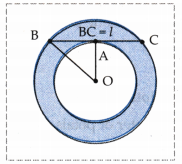
Draw OA ⊥ BC, and join OB
Proof:
Let radius of larger circle be R units, and smaller circle be r units
∵ BC touches the smaller circle at A
OA ⊥ BC ... [Construction]
∴ A is midpoint of BC
... [Perpendicular drawn from the centre of the circle to the chord bisects to chord]
AB = AC = $\frac{1}{2}$ × BC = $\frac{1}{2}$
∵ OB = R, OA = r
In ∆AOB,
By Baudhayana-Pythagoras theorem
OB² = OA² + AB²
R² = r² + $\left(\frac{l}{2}\right)^2$ ...(i)
Area of shaded region = Area of outer circle - Area of inner circle
= πrR² - πr²
= π(R² - r²)
= π[r² + $\frac{l^2}{4}$ - r²] [From (i)]
= $\frac{1}{4}$πl²
∴ Area of shaded region = $\frac{1}{4}$πl²