Construct a rectangle in which one of the diagonals divides the opposite angles into 50° and 40°. Class 6
Construct a rectangle in which one of the diagonals divides the opposite angles into 50° and 40°. Class 6
Question 1.
Construct a rectangle in which one of the diagonals divides the opposite angles into 50° and 40°. Class 6
Solution:
Step 1: Draw line-segment AB of any length (say 6 cm).
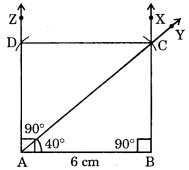
Step 2: At B, make an angle XBA = 90°, using a protractor. ,
Step 3: At point A, make an angle ∠YAB = 40°, using a protractor. Let ray AY intersect ray BX at C.
Step 4: Make angle BAZ = 90°, using a protractor.
Step 5: Using a ruler or compass, mark a point D on ray AZ such that AD = BC.
Step 6: Join C and D, using a ruler.
Then, ABCD is the required rectangle, because ∠DAC = 90° - 40° = 50°.
Note : There cap be another method for making such a rectangle as shown in Method 1 of constructing a rectangle on page 207 of the textbook for 30° and 60° angle.
Question 2.
Construct a rectangle in which one of the diagonals divides the opposite angles into 45° and 45°. What do you observe about the sides? Class 6
Solution:
Step 1: Draw a line-segment PQ of any length (say 5 cm).
Step 2: Using a protractor, make an angle XQP = 90°.
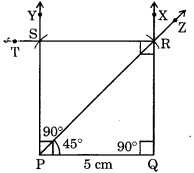
Step 3: Using a protractor, make an angle YPQ = 90°.
Step 4: Using a protractor, make an angle QPZ = 45° and mark the point of intersection of rays QX and PZ as R.
Step 5: At point R, make an angle QRT = 90°, using a protractor and mark the point of intersection of rays RT and PY as S.
Then, PQRS is the required rectangle, because ∠SPR = 90° - 45° = 45° (see figure).
We observe that all sides of this rectangle are equal. In other words, this rectangle PQRS is a square.