Fractions Class 6 MCQ
Fractions Class 6 MCQ
Fractions Class 6 MCQ
Question 1.
A rectangle is divided into equal parts as shown:
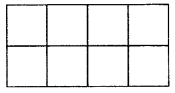
If Anuj shades any 3 parts of the rectangle, what fraction represents the unshaded part?
(a) [latex]\frac {3}{5}[/latex]
(b) [latex]\frac {5}{3}[/latex]
(c) [latex]\frac {3}{8}[/latex]
(d) [latex]\frac {5}{8}[/latex]
Answer:
(d) [latex]\frac {5}{8}[/latex]
Question 2.
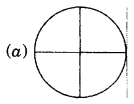
In which of the following models is the fraction represented by the shaded portion the same as the fraction represented by the unshaded portion?
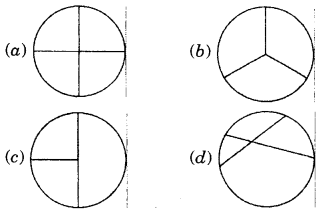
Answer:
Question 3.
Ajay wants to represent a fraction [latex]\frac {3}{5}[/latex] in a rectangular model. What is the minimum number of equal parts he needs to divide the rectangular model into?
(a) 2
(b) 3
(c) 5
(d) 8
Answer:
(c) 5
Question 4.
Ajay divided a square into b equal parts and shaded a part. Which of these represents the numerator of the fraction that represents the unshaded portion?
(a) a
(b) a - b
(c) b - a
(d) a + b
Answer:
(c) b - a
Question 5.
Akriti followed the given steps to represent a fraction on a number line.
- Step 1: Using tick marks, she divided the number line between 0 and 1 into 5 equal parts.
- Step 2: She plotted a point at the 4th tick mark to the right of 0.
What fraction does the point show?
(a) [latex]\frac {1}{5}[/latex]
(b) [latex]\frac {3}{5}[/latex]
(c) [latex]\frac {4}{5}[/latex]
(d) [latex]\frac {4}{9}[/latex]
Answer:
(c) [latex]\frac {4}{5}[/latex]
Question 6.
If [latex]\frac {m}{4}[/latex] is a proper fraction, which option shows the possible values of m?
(a) 1, 2, and 3
(b) 1, 2, 3, and 4
(c) 5, 6, and 7
(d) 4, 5, 6, and 7
Answer:
(a) 1, 2, and 3
Question 7.
A teacher creates an assignment consisting of 19 questions. Of these 19 questions, 7 were easy. The teacher now needs to create another assignment and wants the fraction of easy questions in this assignment to be the same as in the previous one. If the new assignment will have a total of 76 questions, how many easy questions will be in the assignment?
(a) 7
(b) 11
(c) 19
(d) 28
Answer:
(d) 28
Question 8.
Which of the following must be true for fractions [latex]\frac {x}{6}[/latex] and [latex]\frac {12}{y}[/latex] to be equivalent?
(а) The sum of x and y is equal to 18.
(b) The sum of x and y is equal to 72.
(c) The product of x and y is equal to 18.
(d) The product of x and y is equal to 72.
Answer:
(d) The product of x and y is equal to 72.
Question 9.
Consider the fractions [latex]\frac {a}{b}[/latex], [latex]\frac {c}{d}[/latex] and [latex]\frac {p}{q}[/latex] and the following relationships.
- Relation 1: a × d = a × q = c × q = 12
- Relation 2: b × c = b × p = d × p = 12
Which of the given relations verify that the fractions are equivalent?
(a) Both relations together are sufficient, but neither relation is sufficient alone
(b) Relation 2 is sufficient alone, but not Relation 1
(c) Relation 1 is sufficient alone, but not Relation 2
(d) Relations 1 and 2 together are not sufficient
Answer:
(a) Both relations together are sufficient, but neither relation is sufficient alone
Question 10.
Which of these shows the way to express [latex]\frac {16}{24}[/latex] in its simplest form.
(a) Divide 16 and 24 by their greatest common factor.
(b) Divide 16 and 24 by their smallest common multiple.
(c) Multiply 16 and 24 by their smallest common multiple.
(d) Multiply 16 and 24 by their greatest common factor.
Answer:
(a) Divide 16 and 24 by their greatest common factor.
Question 11.
Amrita writes a fraction which is the simplest form of [latex]\frac {5}{15}[/latex]. If the fraction she writes as [latex]\frac {2}{p}[/latex] has the same denominator, then which of the following can be the value of p?
(a) 1
(b) 2
(c) 3
(d) 5
Answer:
(c) 3
Question 12.
If the fractions [latex]\frac {3}{5}[/latex] and [latex]\frac {m}{n}[/latex] have different denominators (n ≠ 0), then which of these shows the possible values of m and n?
(a) m = 3, n = 5.
(b) m can take any value except 3; n = 5.
(c) m = 3 and n can take any value.
(d) m can take any value and n can take any value except 5.
Answer:
(d) m can take any value and n can take any value except 5.
Case Study
I. Shopping
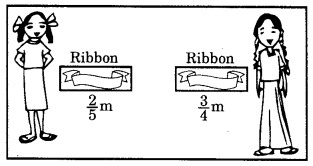
Sarita bought [latex]\frac {2}{5}[/latex]m of ribbon and Anjali bought [latex]\frac {3}{4}[/latex]m of ribbon.
Question 1.
The total length of ribbon bought by them is
(a) [latex]\frac {5}{9}[/latex]m
(b) 1[latex]\frac {3}{20}[/latex]m
(c) 2[latex]\frac {5}{9}[/latex]m
(d) 1[latex]\frac {1}{10}[/latex]m
Answer:
(b) 1[latex]\frac {3}{20}[/latex]m
Question 2.
The difference in the lengths of the ribbons bought by them is
(a) [latex]\frac {1}{5}[/latex]m
(b) [latex]\frac {7}{20}[/latex]m
(c) [latex]\frac {1}{4}[/latex]m
(d) [latex]\frac {3}{10}[/latex]m
Answer:
(b) [latex]\frac {7}{20}[/latex]m
Question 3.
An equivalent fraction of [latex]\frac {2}{5}[/latex] is:
(a) [latex]\frac {2}{10}[/latex]
(b) [latex]\frac {6}{20}[/latex]
(c) [latex]\frac {6}{15}[/latex]
(d) [latex]\frac {8}{15}[/latex]
Answer:
(c) [latex]\frac {6}{15}[/latex]
Question 4.
An equivalent fraction of [latex]\frac {3}{4}[/latex] is
(a) [latex]\frac {9}{12}[/latex]
(b) [latex]\frac {8}{12}[/latex]
(c) [latex]\frac {9}{16}[/latex]
(d) [latex]\frac {8}{16}[/latex]
Answer:
(a) [latex]\frac {9}{12}[/latex]
Question 5.
The mixed number 2[latex]\frac {5}{9}[/latex] can be expresed in the form:
(a) [latex]\frac {19}{9}[/latex]
(b) [latex]\frac {23}{9}[/latex]
(c) [latex]\frac {14}{9}[/latex]
(d) [latex]\frac {47}{9}[/latex]
Answer:
(b) [latex]\frac {23}{9}[/latex]
II. Egyptian Fractions
Ancient Egyptians were only using fractions like [latex]\frac {1}{2}[/latex], [latex]\frac {1}{3}[/latex], [latex]\frac {1}{4}[/latex] and so on. They used to write all other fractions as sums of such different fractions. These fractions are known as unit fractions, because of their numerator 1 in each case.
Using such fractions:
Question 1.
[latex]\frac {5}{8}[/latex] is written as:
(a) [latex]\frac{1}{8}+\frac{1}{2}+\frac{1}{4}[/latex]
(b) [latex]\frac{1}{8}+\frac{1}{4}[/latex]
(c) [latex]\frac{1}{8}+\frac{1}{6}+\frac{1}{4}[/latex]
(d) [latex]\frac{1}{8}+\frac{1}{2}[/latex]
Answer:
(d) [latex]\frac{1}{8}+\frac{1}{2}[/latex]
Question 2.
[latex]\frac {9}{10}[/latex] is written as:
(a) [latex]\frac{1}{3}+\frac{1}{5}+\frac{1}{15}[/latex]
(b) [latex]\frac{1}{2}+\frac{1}{3}+\frac{1}{15}[/latex]
(c) [latex]\frac{1}{2}+\frac{1}{3}+\frac{1}{5}[/latex]
(d) [latex]\frac{1}{2}+\frac{1}{5}+\frac{1}{15}[/latex]
Answer:
(b) [latex]\frac{1}{2}+\frac{1}{3}+\frac{1}{15}[/latex]
Question 3.
[latex]\frac {11}{12}[/latex] is written as:
(a) [latex]\frac{1}{2}+\frac{1}{3}+\frac{1}{6}[/latex]
(b) [latex]\frac{1}{2}+\frac{1}{3}+\frac{1}{4}[/latex]
(c) [latex]\frac{1}{3}+\frac{1}{6}+\frac{1}{4}[/latex]
(d) [latex]\frac{1}{2}+\frac{1}{3}+\frac{1}{12}[/latex]
Answer:
(d) [latex]\frac{1}{2}+\frac{1}{3}+\frac{1}{12}[/latex]
Question 4.
[latex]\frac {11}{18}[/latex] is written as:
(a) [latex]\frac{1}{3}+\frac{1}{9}+\frac{1}{6}[/latex]
(b) [latex]\frac{1}{2}+\frac{1}{9}+\frac{1}{3}[/latex]
(c) [latex]\frac{1}{6}+\frac{1}{9}+\frac{1}{2}[/latex]
(d) [latex]\frac{1}{4}+\frac{1}{6}+\frac{1}{3}[/latex]
Answer:
(a) [latex]\frac{1}{3}+\frac{1}{9}+\frac{1}{6}[/latex]
Question 5.
[latex]\frac {3}{7}[/latex] can be written as:
(a) [latex]\frac{1}{7}+\frac{3}{14}[/latex]
(b) [latex]\frac{1}{3}+\frac{1}{11}+\frac{1}{231}[/latex]
(c) [latex]\frac{1}{7}+\frac{1}{11}+\frac{1}{231}[/latex]
(d) [latex]\frac{1}{3}+\frac{1}{231}+\frac{1}{6}[/latex]
Answer:
(b) [latex]\frac{1}{3}+\frac{1}{11}+\frac{1}{231}[/latex]