If the mid-points of the sides of a 4-gon also known as a quadrilateral, but we prefer to call it a '4-gon' Class 9
If the mid-points of the sides of a 4-gon also known as a quadrilateral, but we prefer to call it a '4-gon' Class 9
Question 1.
If the mid-points of the sides of a 4-gon (also known as a quadrilateral, but we prefer to call it a '4-gon') are joined in order, prove that the area of the parallelogram thus formed will be half of the area of the given 4-gon. (You may wonder whether the 4-gon thus formed is always a parallelogram, and if so, why? These questions will be tackled and answered in the chapter on quadrilaterals.) Class 9
Solution:
Given: Let ABCD be a 4-gon. Let P, Q, R and S be midpoints of sides AB, BC, CD and DA respectively.
To prove: A (∠PQRS) = $\frac{1}{2}$ A (∠ABCD)
Construction: Join diagonals AC and BD. Join CP
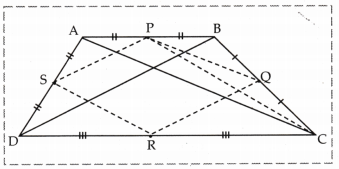
Proof:
∴ P is the midpoint of side AB ... [Given]
CP is the median of ∆ABC
A(∆BCP) = $\frac{1}{2}$A(∆ABC)
....(i) [Median of a triangle divides it into two triangles of equal area.]
Now, Q is the midpoint of side BC ... [Given]
∴ PQ is median of ∆BCP
∴ A(∆PBQ) = $\frac{1}{2}$A(∆BCP) ...(ii) [Median of a triangle divides it into two triangles of equal area]
Substituting (i) in (ii), we get
∴ A(∆PBQ) = $\frac{1}{2}$ x $\frac{1}{2}$ A(∆ABC)
∴ A(∆PBQ) = $\frac{1}{2}$ A(∆ABC)
Similarly, we can show that,
A (∆RDS) = $\frac{1}{4}$ A(∆ADC) ... (iv)
A(∆QCR) = $\frac{1}{4}$A(∆BCD) ...(v)
A(∆SAP) = $\frac{1}{4}$A(∆DAB) ... (vi)
Adding (iii) and (iv), we get
A(∆PBQ) + A(∆RDS)
= $\frac{1}{4}$[A(∆ABC) + A(∆ADC)]
= $\frac{1}{4}$A(∠ABCD) ...(vii)
Adding (v) and (vi), we get
A(∆QCR) + A(∆SAP)
= $\frac{1}{4}$ [A(∆BCD) + A(∆DAB)]
= $\frac{1}{2}$ A(∠ABCD) ...(viii)
Again adding (vii) and (viii), we get
A(∆PBQ) + A(∆RDS) + A(∆QCR) + A(∆SAP) = $\frac{1}{2}$ A(∠ABCD) ...(ix)
But, A (∆PBQ) + A(∆RDS) + A(∆QCR) + A(∆SAP) + A(∠PQRS) = A (∠ABCD) ...(x)
Subtracting (ix) from (x), we get
A(∠PQRS) = $\frac{1}{2}$ A(∠ABCD)
Hence proved.