In ∆ABC, D is the midpoint of AB. P is any point on BC, and Q is a point on AB such that CQ || PD. Class 9
In ∆ABC, D is the midpoint of AB. P is any point on BC, and Q is a point on AB such that CQ || PD. Class 9
Question 1.
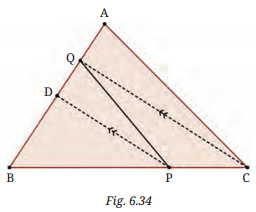
In ∆ABC, D is the midpoint of AB. P is any point on BC, and Q is a point on AB such that CQ || PD. PQ is joined (Fig. 6.34). Prove that Area (∆BPQ) = $\frac{1}{2}$ Area (∆ABC). Class 9
Solution:
Given: D is midpoint of AB. Q is a point on
AB such that CQ || PD
To prove: A(∆BPQ) = $\frac{1}{2}$ A(∆ABC)
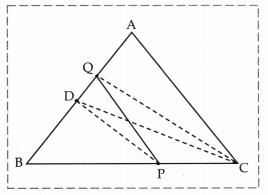
Construction: Joint point C and D.
Proof:
D is midpoint of AB. ...[Given]
∴ CD is median of ∆ABC
∴ A(∆BCD) = $\frac{1}{2}$ × A(∆ABC) ...(i) [Median of a triangle divides it into two triangles of equal area.]
But
A(∆BCD) = A(∆BDP) + A(∆PDC) ...(ii)
Now,
CQ || PD ...[Given]
∴ ∆PDC and ∆PDQ lie on same base PD and same parallel lines.
∴ A(∆PDC) = A(∆PDQ) ... (iii)
From (ii),
A(∆BCD) = A(∆BDP) + A(∆PDQ)
∴ A(∆BCD) = A(∆BPQ) .. .(iv)
Substituting (iv) in (i) we get
A (∆BPQ) = $\frac{1}{2}$ A(∆ABC)