In Fig. 6.1, you see athletes assembled at the start of a 4 x 100 m relay race. The tracks are laid out Class 9
In Fig. 6.1, you see athletes assembled at the start of a 4 x 100 m relay race. The tracks are laid out Class 9
Question 1.
In Fig. 6.1, you see athletes assembled at the start of a 4 x 100 m relay race. The tracks are laid out, and the athletes are all set to go racing down the tracks. Do you notice that the athletes are not at the same starting line? Class 9
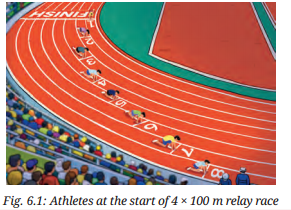
Those in the outer lanes seem to be starting ahead of those in the inner lanes while the finish line is the same for all of them.
What could be the reason for this? The distance between the starting points of adjacent lanes is called the 'stagger'. Notice that the stagger continues all the way to the outermost lane.
Do you think the stagger gives anyone (those in the outermost lane or in the inner lanes) an unfair advantage? Why or why not? On what basis can the organisers work out the length of the stagger between lanes?
Answer:
Those in the outer lanes appear to start ahead because the paths along the outer lanes are longer than those along the inner lanes. This is due to the curved portions of the track, where the outer lanes have a larger radius and hence a greater length around the circle.
The distance between the starting points of adjacent lanes, called the stagger, is introduced to ensure that each athlete runs the same total distance.
Stagger = 2πw
Where w = Lane width
Thus, the stagger does not give any unfair advantage to any runner. It compensates for the extra distance in the outer lanes.
To work out the length of the stagger, organisers use the idea of the length around a circle (circumference). Since different lanes correspond to circles of different radii, their lengths are different, and the stagger is calculated accordingly.