In my school, the playground is too small to have a 400 m track, so the school constructed Class 9
In my school, the playground is too small to have a 400 m track, so the school constructed Class 9
Question 1.
In my school, the playground is too small to have a 400 m track, so the school constructed a 200 m track instead. Does this mean that we need a smaller stagger for the race tracks in my school (i.e., smaller than the stagger used in the Olympics), for the same 4 × 100 m relay race? Class 9
Answer:
No, we do not need a smaller stagger in a 200 m track. The stagger remains the same.
The stagger is given to adjust for the extra distance run in the curved parts of the track. This extra distance depends on the difference in radii between adjacent lanes, which is equal to the lane width.
Since the lane width is the same in both 200 m and 400 m tracks, the difference in distances between lanes remains the same. Therefore, the stagger required between adjacent lanes is the same, regardless of the size of the track.
Question 2.
Here we see a circle with radius r units. What is its perimeter? How do we find out? Class 9
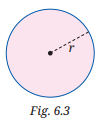
In the given figure, we see a circle with radius r units what its perimeter? How do we find out?
Answer:
Take a thin thread and wrap it once around a circular object. Then straighten the thread and measure its length. This gives the perimeter of the circle.
Now measure the diameter of the same circle and find the ratio: $\frac{\text { Perimeter }}{\text { Diameter }}$
If we repeat this activity using circles of different sizes, we observe that this ratio is always a little more than 3. This constant ratio is represented by the symbol π.