Let ∆ABC be the triangle, D divides side AB into two parts and E and F divides AC into three equal parts. Class 9
Let ∆ABC be the triangle, D divides side AB into two parts and E and F divides AC into three equal parts. Class 9
Question 1.
Solution:
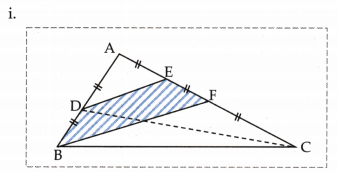
Let ∆ABC be the triangle, D divides side AB into two parts and E and F divides AC into three equal parts.
∴ AD = DB = $\frac{1}{2}$ AB, AE = EF = FC = $\frac{1}{3}$ AC ...(i)
Let Area of ∆ABC = A
Join DC.
Here D is mid point of AB ... [Given]
∴ CD is median of ABC.
∴ A (∆ ADC) = A (∆ BDC) = $\frac{\mathrm{A}}{2}$
... (ii) [∵ median of a triangle divides the triangle into two equal triangles.]
Now, ∆ ADE and ∆ADC have same height.
$\begin{aligned} \therefore \quad \frac{\mathrm{A}(\triangle \mathrm{ADE})}{\mathrm{A}(\triangle \mathrm{ADC})} & =\frac{\frac{1}{2} \times \mathrm{AE} \times \text { height }}{\frac{1}{2} \times \mathrm{AC} \times \text { height }}=\frac{\mathrm{AE}}{\mathrm{AC}} \\ \ldots[\text { Area of triangle } & \left.=\frac{1}{2} \times \text { base × height }\right]\end{aligned}$
$\because \quad$ But, $\mathrm{AE}=\frac{1}{3} \mathrm{AC}$
...[From (i)]
$\begin{array}{ll}\therefore & \frac{\mathrm{A}(\triangle \mathrm{ADE})}{\mathrm{A}(\triangle \mathrm{ADC})}=\frac{\frac{1}{3} \times \mathrm{AC}}{\mathrm{AC}}=\frac{1}{3} \\ \therefore & \mathrm{~A}(\triangle \mathrm{ADE})=\frac{1}{3} \times \mathrm{A}(\triangle \mathrm{ADC})\end{array}$
$=\frac{1}{3} \times \frac{\mathrm{A}}{2} \quad \ldots[$ From (ii) $]$
∴ A (∆ADE) = $\frac{\mathrm{A}}{6}$ .....(iii)
Now, ∆BFC and ∆ ABC have same height.
$\frac{\mathrm{A}(\triangle \mathrm{BFC})}{\mathrm{A}(\triangle \mathrm{ABC})}=\frac{\frac{1}{2} \times \mathrm{FC} \times \text { height }}{\frac{1}{2} \times \mathrm{AC} \times \text { height }}=\frac{\mathrm{FC}}{\mathrm{AC}}$
....[Area of triangle = $\frac{1}{2}$ × base × height]
But FC = $\frac{1}{3}$AC ...[From (i)]
$\begin{array}{ll}\therefore & \frac{\mathrm{A}(\triangle \mathrm{BFC})}{\mathrm{A}(\triangle \mathrm{ABC})}=\frac{\frac{1}{3} \times \mathrm{AC}}{\mathrm{AC}}=\frac{1}{3} \\ \therefore & \mathrm{~A}(\triangle \mathrm{BFC})=\frac{1}{3} \times \mathrm{A}(\triangle \mathrm{ABC})\end{array}$
∴ A(∆BFC) = $\frac{\mathrm{A}}{3}$ ...(iv)
Now,
Shaded area=A(∆ABC) - A(∆ADE) - A(∆BFC)
$\begin{aligned} & =A-\frac{A}{6}-\frac{A}{3} \quad \ldots[\text { From (iii) and (iv) }] \\ & =\frac{6 A-A-2 A}{6} \\ & =\frac{3 A}{6}=\frac{A}{2}\end{aligned}$
∴ Fraction of shaded region = $\frac{1}{2}$
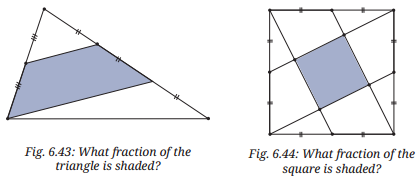
ii. The tick marks show that each marked point is the midpoint of a side of the large square. Lines are drawn from each vertex to the midpoint of the opposite side, forming the shaded square in the centre.
Observe the four comer regions:
Each corner region is a right-angled triangle.
Since they are formed using the midpoints, all four triangles are congruent (equal in size).
Now imagine cutting these four identical triangles and rearranging them around the shaded square. They can form 4 more squares equal in area to the shaded square. So, the whole large square is made up of:
1 shaded square + 4 equal squares = 5 equal parts
Therefore,
Fraction of square shaded = $\frac{1}{5}$