Lines and Angles Class 6 MCQ
easyLines and Angles Class 6 MCQ
Lines and Angles Class 6 MCQ
Question 1.
Which of these cannot be represented by a point?
(a) Tip of the needle
(b) A vertex of a triangle
(c) Tip of pen
(d) Length of a box
Answer:
(d) Length of a box
Question 2.
A point determines the ____ on a map.
(a) location of a place
(b) distance between two places
(c) direction
(d) roads
Answer:
(a) location of a place
Question 3.
Consider the line segments shown.
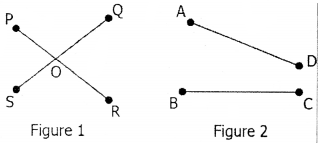
Which of these figures represent(s) intersecting line segments and why?
(a) Figure 1; because line segments have no point in common.
(b) Figure 1, because line segments have point O in common.
(c) Figure 2, because line segments have point D in common.
(d) Figure 2; because line segments have no point in common.
Answer:
(b) Figure 1, because line segments have point O in common.
Question 4.
Which pair of lines in the following figure are not intersecting with each other?
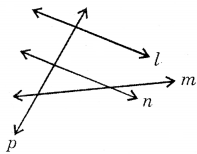
(a) m and n
(b) m and p
(c) l and p
(d) l and n
Answer:
(d) l and n
Question 5.
Observe the figure below.
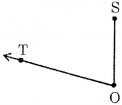
Which of the following is NOT true about the given figure?
(a) OT denotes a ray.
(b) TO denotes a ray.
(c) OS denotes a line segment.
(d) SO denotes a line segment.
Answer:
(b) TO denotes a ray.
Question 6.
Which statement(s) is/are correct about the figure shown below?
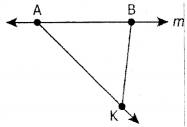
Statement 1: AB and m represent the same line.
Statement 2: Both AK and BK are rays.
(a) Only statement 1
(b) Only statement 2
(c) Both statements 1 and 2
(d) Neither statement 1 nor statement 2
Answer:
(a) Only statement 1
Question 7.
Which of these will result in a straight angle?
(а) Turn from East to North at a right angle
(b) Turn from South to East by three right angles
(c) Turn from North to South by two right angles
(d) Turn from West to South by three right angles
Answer:
(c) Turn from North to South by two right angles
Question 8.
Consider the angles shown.
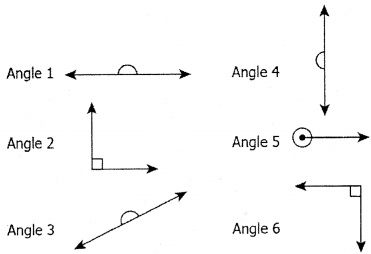
Which option correctly classifies the given angles?
(а) There are 3 right angles, 2 straight angles, and 1 complete angle
(b) There are 2 right angles, 3 straight angles, and 1 complete angle
(c) There are 3. right angles, 1 straight angle, and 2 complete angles
(d) There are 2 right angles, 1 straight angle, and 2 complete angles
Answer:
(b) There are 2 right angles, 3 straight angles, and 1 complete angle
Question 9.
A ladder is placed against a wall as shown below.
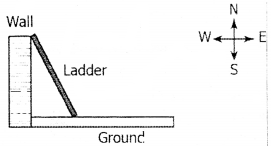
If the feet of the ladder are pulled towards the east such that they remain on the ground only, which statement best describes the effect on the inside angle between the wall and the ladder?
(a) The inside angle between the wall and the ladder will still be acute.
(b) The inside angle between the wall and the ladder will still be obtuse.
(c) The inside angle between the wall and the ladder will change from obtuse to a right angle.
(d) The inside angle between the wall and the ladder will change from acute to an obtuse angle.
Answer:
(a) The inside angle between the wall and the ladder will still be acute.
Question 10.
Consider the statements.
Statement 1: Taking a turn from South to North by two right angles will form a straight angle.
Statement 2: Taking a turn from West to South by three right angles will form a reflex angle.
Which of these statements is/are correct?
(a) Only Statement 1
(b) Only Statement 2
(c) Both Statement 1 and Statement 2
(d) Neither Statement 1 nor Statement 2
Answer:
(c) Both Statement 1 and Statement 2
Question 11.
Consider the letters of the English alphabet given below:

How many letters have at least one perpendicular line?
(a) One
(b) Two
(c) Three
(d) Four
Answer:
(d) Four
Question 12.
Some books are placed on a wooden shelf as shown.
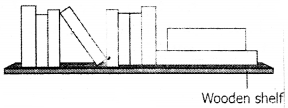
How many books are perpendicular to the wooden shelf?
(a) 1
(b) 2
(c) 7
(d) 8
Answer:
(d) 8
Case Study
Eight students, A, B, C, D, E, F, G, and H, stood along the boundary of a circular field, dividing it into 8 equal parts. The teacher stood at the centre of the field. The teacher first faces student A (see figure).
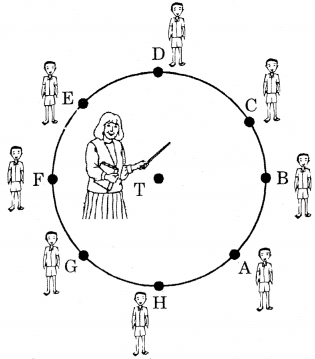
Choose the correct option in each of these questions:
Question 1.
Teacher takes a 135° turn anticlockwise. Now, the teacher is facing towards the student:
(a) C
(b) D
(c) E
(d) G
Answer:
(b) D
Question 2.
After this, the teacher turns 90° clockwise again. Now, she is facing the student:
(a) B
(b) C
(c) F
(d) H
Answer:
(a) B
Question 3.
Now, the teacher turns 135° anticlockwise again. Then, she must be facing a student:
(a) G
(b) E
(c) C
(d) D
Answer:
(b) E
Question 4.
Again, she turns 90° anticlockwise. Then, she must be facing a student:
(a) G
(b) F
(c) D
(d) H
Answer:
(a) G
Question 5.
Now, she turns 45° clockwise. Towards which student is she facing now?
(a) G
(b) H
(c) F
(d) E
Answer:
(c) F
On a blackboard, some points are marked on a line l as shown below:
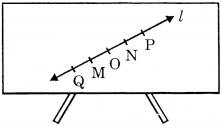
Choose the correct option in each of these questions:
Question 1.
How many different rays do you observe in this figure?
(a) 6
(b) 7
(c) 8
(d) 9
Answer:
(c) 8
Question 2.
How many line segments do you observe in this figure?
(a) 10
(b) 9
(c) 8
(d) 7
Answer:
(a) 10
Question 3.
The number of line segments with Q as an endpoint is
(a) 1
(b) 2
(c) 3
(d) 4
Answer:
(d) 4
Question 4.
The number of different rays with Q as the starting point is
(a) 1
(b) 2
(c) 3
(d) 4
Answer:
(a) 1
Question 5.
The number of different rays with M as the starting point is
(a) 1
(b) 2
(c) 3
(d) 4
Answer:
(b) 2