Playing with Constructions Class 6 MCQ
Playing with Constructions Class 6 MCQ
Playing with Constructions Class 6 MCQ
Question 1.
A teacher asked his students to list the minimum tools required to draw a square inscribed in a circle. The responses of two of the students are shown.
- Student 1: Ruler and compass
- Student 2: Set-square and compass
Who among them is/are correct?
(a) Only Student 1
(b) Only Student 2
(c) Both Student 1 and Student 2
(d) Neither Student 1 nor Student 2
Answer:
(c) Both Student 1 and Student 2
Question 2.
To draw a circle of radius 6 cm, Anjali writes the following steps.
- Step 1: Draw a line segment EF of 6 cm.
- Step 2: Mark the mid-point of the line segment, say G.
- Step 3: Taking G as the centre and GF as the arc, draw the required circle.
Are her steps for the required construction correct?
(a) Yes, because EF = 2GF
(b) No, because the centre of the circle should lie in between G and F.
(c) Yes, because EF is the radius of the circle and its length is 6 cm.
(d) No, because the centre of the circle should either be E or F.
Answer:
(d) No, because the centre of the circle should either be E or F.
Question 3.
Kunal wrote the following steps to construct a line segment of 7 cm.
- Step 1: Draw a line k. Mark a point M on the line k.
- Step 2: Place the compass pointer on the mark “1” of the ruler.
- Step 3: Open the compass to place the pencil point up to the mark “9” of the ruler.
- Step 4: Taking caution that the opening of the compass has not changed, place the pointer on M and draw an arc to cut k at N to get [latex]\overline{\mathrm{MN}}[/latex] = 7 cm.
Kunal made an error while constructing the line segment. In which step did he make the error?
(a) Step 1
(b) Step 2
(c) Step 3
(d) Step 4
Answer:
(c) Step 3
Question 4.
Which of the following is not a name for this rectangle?
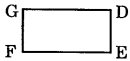
(a) EFGD
(b) FDGE
(c) DEFG
(d) FEDG
Answer:
(b) FDGE
Question 5.
In a rectangle ABCD, if X is any point on AD and Y is any point on BC, then the minimum distance between points X and Y is equal to
(a) AC
(b) BC
(c) BD
(d) CD
Answer:
(d) CD
Question 6.
In a rectangle PQRS, if A is any point on PQ ad B is any point on RS, then the farthest distance between A and B is
(a) QS
(b) PQ
(c) QR
(d) RS
Answer:
(a) QS
Question 7.
For constructing a rectangle that can be divided into two identical squares, its length cannot be
(a) 3 cm
(b) 3.5 cm
(c) 4.6 cm
(d) 8.4 cm
Answer:
(b) 3.5 cm
Question 8.
For constructing a rectangle that can be divided into three identical squares, its length cannot be
(a) 4.5 cm
(b) 4.8 cm
(c) 6.8 cm
(d) 7.2 cm
Answer:
(c) 6.8 cm
Question 9.
For constructing a square in the middle of a rectangle of sides 10 cm and 4 cm, the distance between the corners of the square and the outer rectangle will be
(a) 5 cm
(b) 4 cm
(c) 3 cm
(d) 2 cm
Answer:
(c) 3 cm
Question 10.
For constructing a square in the middle of a rectangle of sides 18 cm and 9 cm, the distance between the corners of the square and the outer rectangle will be
(a) 4.5 cm
(b) 5 cm
(c) 6 cm
(d) 7.5 cm
Answer:
(a) 4.5 cm