Playing with Constructions Class 6 Notes
Playing with Constructions Class 6 Notes
Playing with Constructions Class 6 Notes
1. Valid Name: A name for a polygon that follows the rule of listing the vertices in the order they are connected around the shape.
2. Compass: A drawing tool used to create arcs and circles by marking points at a fixed distance from a central point.
3. Curves: Any shape that can be drawn on paper, including straight lines, circles, and other figures.
4. Identical Squares: Squares that have the same dimensions and properties., such as equal side lengths and angles.
5. Perpendicular Lines: Lines that intersect at a right angle (90 degrees).
6. Construction: The process of drawing geometric figures using specific tools like a ruler and compass, following certain rules and methods.
7. 4-Sided Figure (Quadrilateral): A polygon with four sides, which can include rectangles, squares, trapezoids (trapeziums) and rhombuses.
8. Symmetrical Figure: A figure that can be divided into two identical halves that are mirror images of each other.
9. Supporting Curves: Additional curves or figures that assist in the construction of a primary geometric figure but are not part of the final figure.
10. Rough Diagram: A preliminary sketch that helps visualize the final figure before precise construction.
Artwork
Artwork in geometry involves drawing shapes that follow specific rules. For example, when you draw a square, you need to make sure all four sides are equal and all angles are 90 degrees. Using a compass, you can create perfect circles, and with a ruler, you can draw straight lines.
Squares and Rectangles
In this section, we learn about two important shapes in geometry squares and rectangles. These shapes are all around us, and under¬standing their properties can help us in many ways!
A square is a special type of rectangle. Here are the key features of a square :
- Four Equal Sides: All sides of a square are of the same length. For example, if one side is 5 cm, all the other sides are also 5 cm.
- Right Angles: Each corner of a square has a right angle (90 degrees). This means the sides meet at square corners.
A rectangle is another type of quadrilateral (four-sided shape). Here are its features :
- Opposite Sides are Equal: In a rectangle, the opposite sides are equal in length. For example, if one side is 4 cm, the opposite side is also 4 cm, but the other two sides can be different lengths, like 6 cm.
- Right Angles: Just like squares, all corners of a rectangle are right angles (90 degrees).
How to name a rectangle or a square?
The name given to it: ABCD. It can also be named in other ways — BCDA, CDAB, DABC, ADCB, DCBA, CBAD and BADC. In a valid name, the corner occur in an order of travel around the rectangle, starting from any corner.
Constructing Squares and Rectangles
An Exploration in Rectangles
Exploring Diagonals of Rectangles and Squares
A diagonal is a line that connects two opposite corners (or vertices) of a shape. In rectangles and squares, each shape has two diagonals.
In a Rectangle : If you have a rectangle with corners labelled as P, Q, R and S, the diagonals would be :
- Diagonal PR (connecting corner P to corner R)
- Diagonal QS (connecting corner Q to comer S)
Here’s a simple diagram to visualize it :
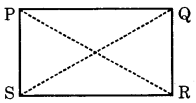
In this rectangle:
- Diagonal PR connects points P and R.
- Diagonal QS connects points Q and S.
Properties of Diagonals
- Equal Lengths: In a rectangle, both diagonals are equal in length. This means that if you measure diagonal PR and diagonal QS, they will be equal!
- Divide Angles: The diagonals also divide the angles of the rectangle into smaller angles. For example, diagonal PR divides angle P into two smaller angles.
- Right Angles: In a square, which is a special type of rectangle, the diagonals also meet at right angles (90 degrees)'at the centre of the square.
Points Equidistant from Two Given Points