Symmetry Class 6 MCQ
Symmetry Class 6 MCQ
Symmetry Class 6 MCQ
Question 1.
Which of these objects is symmetrical?
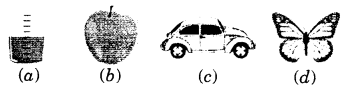
Answer:

Question 2.
Consider the object shown.
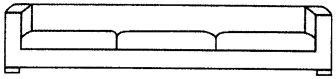
Which of these could be the line of symmetry of the object?
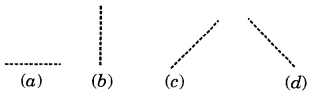
Answer:

Question 3.
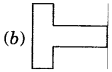
Which of these figures shows exactly one line of symmetry?
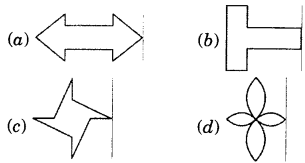
Answer:
Question 4.
Consider the figure given below:
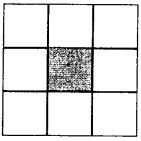
How should the figure be changed so that it has exactly two lines of symmetry?
(a) Shading all the corners of the figure.
(b) Shading two corners of the first row of the figure.
(c) Shading the second row and the second column of the figure.
(d) Shading all the boxes in the first and last row of the figure.
Answer:
(d) Shading all the boxes in the first and last row of the figure.
Question 5.
If an object is placed at a distance of 12 cm from the mirror, how far behind the mirror is the image?
(a) 0 cm
(b) 12 cm
(c) 24 cm
(d) 144 cm
Answer:
(b) 12 cm
Question 6.
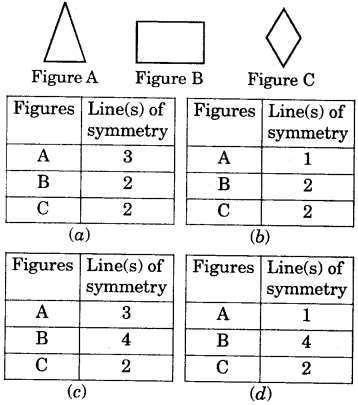
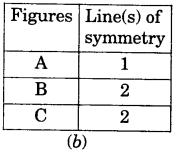
Observe the figures below and choose the correct option.
Answer:
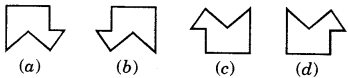
Question 7.
Consider the figure shown.

Which of these is the mirror image of the figure along the line l?
Answer:

Question 8.
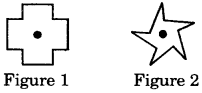
Consider the figures shown.
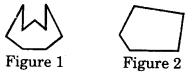
A student made the following conclusions after observing the figures.
- Conclusion I: Figure 1 has line symmetry, as there is a line about which it can be folded so that the two parts coincide.
- Conclusion II: Figure 2 has no line symmetry, as there is no line about which it can be folded so that the two parts coincide.
Which of the above conclusions is/are correct?
(а) Only Conclusion I
(b) Only Conclusion II
(c) Both Conclusion I and Conclusion II
(d) Neither Conclusion I nor Conclusion II
Answer:
(c) Both Conclusion I and Conclusion II
Question 9.
How many lines of symmetry does a regular hexagon have?
(a) 4
(b) 6
(c) 7
(d) 3
Answer:
(b) 6
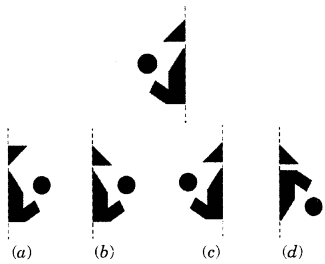
Question 10.
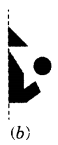
If the dotted line represents the mirror line, which of the following figures is the other part of the given figure?
Answer:
Question 11.
Which of these letters does not have rotational symmetry about its centre?
(a) H
(b) O
(c) N
(d) E
Answer:
(d) E
Question 12.
What is the angle of symmetry of the given figure?

(a) 60°
(b) 30°
(c) 45°
(d) 72°
Answer:
(a) 60°
Question 13.
A regular hexagon is cut along one of its lines of symmetry as shown.

Is it true that the angle of rotation of the new figure is half that of the previous figure? If not, at what angle should it be turned to get back to the original position?
(а) No, the angle of rotation should be 120°
(b) No, the angle of rotation should be 180°
(c) Yes
(d) No, the angle of rotation should be 60°
Answer:
(b) No, the angle of rotation should be 180°
Question 14.
What is the order of rotation of the given figure?

(a) 3
(b) 4
(c) 2
(d) 6
Answer:
(c) 2
Question 15.
Observing the figures below, a student made the following conclusions:
- Conclusion I: Figure 1 has a rotational symmetry of order 4.
- Conclusion II: Figure 2 has rotational symmetry of order 5.
Which of the above conclusions is/are correct?
(а) Only Conclusion I
(b) Only Conclusion II
(c) Both Conclusion I and Conclusion II
(d) Neither Conclusion I nor Conclusion II
Answer:
(b) Only Conclusion II
Case Study
I. Number of Lines of Symmetry
Question 1.
The number of lines of symmetry in the figure is

(a) 1
(b) 2
(c) 3
(d) more than 3
Answer:
(a) 1
Question 2.
The number of lines of symmetry in the figure is

(a) 2
(b) 3
(c) 4
(d) 6
Answer:
(d) 6
Question 3.
The number of lines of symmetry in the figure is

(a) 0
(b) 2
(c) 4
(d) infinitely many
Answer:
(d) infinitely many
Question 4.
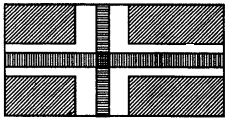
The number of lines of symmetry in the figure is
(a) 0
(b) 1
(c) 2
(d) 4
Answer:
(b) 1
Question 5.
The number of lines of symmetry in the figure is

(a) 2
(b) 3
(c) 4
(d) 6
Answer:
(c) 4
II. Line and Rotational Symmetry
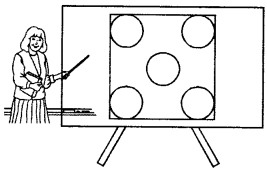
A design is drawn on the blackboard by the teacher.
Question 1.
The number of lines of symmetry for this design is
(a) 2
(b) 4
(c) 6
(d) infinity many
Answer:
(b) 4
Question 2.
An angle of symmetry for this figure is:
(a) 45°
(b) 60°
(c) 75°
(d) 90°
Answer:
(d) 90°
Question 3.
The order of rotational symmetry for this figure is:
(a) 6
(b) 4
(c) 3
(d) 2
Answer:
(b) 4
Question 4.
The number of lines of symmetry in a circle is:
(a) 16
(b) 10
(c) 8
(d) more than 16
Answer:
(d) more than 16
Question 5.
The order of rotational symmetry for a circle is:
(a) 50
(b) 40
(c) 100
(d) infinity many
Answer:
(d) infinity many