Symmetry Class 6 Notes
Symmetry Class 6 Notes
Symmetry Class 6 Notes
1. Symmetry: A property where a shape or figure can be divided into two identical parts that are mirror images of each other.
2. Line of Symmetry: A line that divides a figure into two identical halves, such that one half is a mirror image of the other.
3. Reflection Symmetry: A type of symmetry where one half of a figure is a mirror image of the other half when divided by a line of symmetry.
4. Vertical Fold: A fold made along a vertical line, which can create symmetrical shapes when the paper is cut and unfolded.
5. Horizontal Fold: A fold made along a horizontal line, which also can create symmetrical shapes upon
unfolding.
6. Diagonal Fold: A fold made along a diagonal line, which can produce different symmetrical patterns when the paper is cut and unfolded.
7. Rotational Symmetry: A property of a shape that looks the same after a certain amount of rotation around a central point.
8. Angle of Symmetry: The angle through which a figure can be rotated to look exactly the same as it did before the rotation.
9. Intricate Patterns: Complex designs created by folding and cutting paper, often resulting in symmetrical shapes.
10. Punching Game: An activity where holes are punched in a folded piece of paper to create symmetric patterns upon unfolding.
11. Ink Blot Technique: A method of creating symmetrical designs by folding paper, applying ink or paint to one side, and then pressing the halves together.
12. Decorative Paper Cut-outs: Artistic designs made from paper that utilize symmetry, often used for festive occasions.
13. Asymmetrical Figures: Shapes that do not have a line of symmetry and cannot be divided into two identical halves.
14. Folding Techniques: Various methods of folding paper to explore and create symmetrical shapes and designs.
Line of Symmetry
What is a Line of Symmetry ?
A line of symmetry is like an invisible line that divides a shape into two equal parts. When you fold the shape along this line, both halves match perfectly, just like mirror images! If you can fold a shape and the two sides overlap exactly, then that line is called a line of symmetry.
Understanding with an Example :
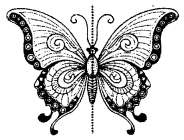
Imagine you have a butterfly. If you draw a line down the middle of the butterfly, from the top to the bottom, you will see that the left side looks just like the right side. This line is the line of symmetry for the butterfly.
Rotational Symmetry
Rotational symmetry is a special property of shapes that allows them to look the same after being rotated (turned) around a central point. This means that if you spin the shape around a point, it will match up with its original position at certain angles.
Understanding with an Example :
Imagine a paper windmill. If you rotate it by 90 degrees (a quarter turn), it looks exactly the same as it did before you turned it. This means the windmill has rotational symmetry!
Real-World Example : The Paper Windmill
Here’s a simple drawing to help you visualize :
In this drawing of a paper windmill, the centre point is where you would rotate it. If you turn the windmill :
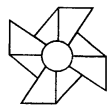
- 90 degrees : It still looks the same.
- 180 degrees : It still looks the same.
- 270 degrees : It still looks the same.
- 360 degrees : It looks the same again, just like the starting position!
How to Find Rotational Symmetry :
- Identify the Centre: Find the point around which you will rotate the shape.
- Rotate the Shape: Turn the shape by certain angles (like 90 degrees, 180 degrees, etc.).
- Check for Matches: See if the shape looks the same after each rotation.
More Examples of Rotational Symmetry :
- Star Shape: A five-pointed star has rotational symmetry. If you rotate it by 72 degrees (360 degrees divided by 5), it looks the same at each point.
- Circle: A circle has infinite rotational symmetry because you can rotate it by any angle, and it will always look the same.
- Regular Hexagon: A regular hexagon (a six-sided shape) has rotational symmetry. It looks the same when rotated by 60 degrees, 120 degrees, 180 degrees, 240 degrees, 300 degrees and 360 degrees.
- Order of Rotational Symmetry: The number of angles of symmetry of a figure is called its order of rotational symmetry. For example, order of rotational symmetry of a square is 4.