The given figure shows Stages 0 to 3 of the Sierpinski square carpet. Stage 0 of this fractal Class 9
The given figure shows Stages 0 to 3 of the Sierpinski square carpet. Stage 0 of this fractal Class 9
Question 1.
The given figure shows Stages 0 to 3 of the Sierpinski square carpet. Stage 0 of this fractal is a square sheet of paper. To construct Stage 1, each side of the square is trisected and the points of trisection of opposite sides are joined to obtain nine smaller squares. The centre square is then removed and the 8 smaller squares are retained, leaving a square hole in the centre. The same process is repeated on the eight smaller shaded squares to obtain Stage 2 and so on.
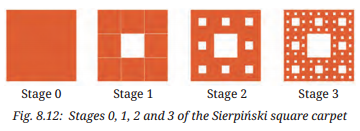
Stages 0, 1, 2 and 3 of the Sierpinski square carpet
Look at the above figure and try to answer the following questions.
i. How many red squares are there in Stages 0 to 3?
ii. Can you predict the number of red squares in Stages 4 and 5?
iii. Can you find a rule for the number of red squares at the nth stage? Write the explicit formula as well as the recursive formula for the number of red squares at any stage.
iv. Suppose the area of the square in Stage 0 is 1 square unit. What is the area of the red region in Stages 1, 2 and 3? What will be the area of the red region in Stages 4 and 5? Find the explicit as well as the recursive formula for the area of the red region at the nth stage. What happens to this area as n, the number of stages, goes on increasing?
Solution:
At each stage, every shaded square is divided into a 9 smaller squares and the centre one is removed,
∴ Each red square produces 8 new sequence in the next stage.
i. Number of red squares in Stages 0 to 3 are
| Stage (n) | 0 | 1 | 2 | 3 |
| Red squares (tn) | 1 = 80 | 8 = 81 | 64 = 82 | 512 = 83 |
ii. At stage 4,
Number of red squares = 84 = 4096
At stage 5,
Number of red squares = 85 = 32768
iii. Yes,
From the pattern observed in the table, the number of red squares is a geometric sequence with first term t0 = 1 and common ratio r = 8.
Explicit Formula:
Since each stage multiplies the number of squares by 8,
∴ tn = 8n
Recursive Formula:
Since each term is 8 times the previous term,
∴ t0 = 1, tn = 8 × tn-1 for n ≥ 1
iv. At each stage, area of each small square = $\left(\frac{1}{9}\right)$ of previous stage
∴ Area of each small square at nth stage = $\left(\frac{1}{9}\right)^n$
At nth stage, Number of red squares = 8n
∴ Total red area at nth stage = Number of red squares × Area of each small square
Sn = 8n × $\left(\frac{1}{9}\right)^n=\left(\frac{8}{9}\right)^n$
| Stage (n) | Red squares (tn) | Red Area (Sn) |
| 0 | 1 = 8 | 1 |
| 1 | 8 = 81 | $\frac{8}{9}$ |
| 2 | 64 = 82 | $\left(\frac{8}{9}\right)^2$ |
| 3 | 512 = 83 | $\left(\frac{8}{9}\right)^3$ |
| 4 | 84 | $\left(\frac{8}{9}\right)^4$ |
| 5 | 85 | $\left(\frac{8}{9}\right)^5$ |
| … | … | … |
| n | 8n | $\left(\frac{8}{9}\right)^n$ |
The explicit formula for the area of the red region at the nth stage is
Sn = $\left(\frac{8}{9}\right)^n$ and
The recursive formula is,
S0 = 1, Sn = $\left(\frac{8}{9}\right)$ × Sn-1 for n ≥ 1
Thus, while the number of red squares increases rapidly, the total area of the red region decreases.