The parallel sides of a trapezium are 40 cm and 20 cm. If its non-parallel sides are both equal Class 9
The parallel sides of a trapezium are 40 cm and 20 cm. If its non-parallel sides are both equal Class 9
Question 1.
The parallel sides of a trapezium are 40 cm and 20 cm. If its non-parallel sides are both equal, each being 26 cm, find the area of the trapezium. Class 9
Solution:
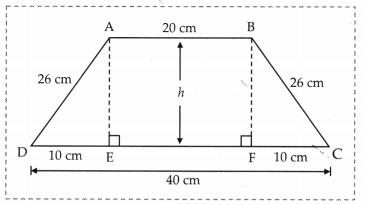
Let ▢ABCD be trapezium, AB = 20 cm,
CD = 40 cm and height be h cm.
AB = EF = 20 cm
Now, DC = 40 cm.
∴ DE + EF + FC = 40 cm
DE + 20 + FC = 40 cm
∴ DE + FC = 20 cm
∴ 2DE = 20 cm ...[▢ABCD is isosceles trapezium, ∆ AED is congruent to ∆ BFC]
By Baudhayana's-Pythagoras theorem,
AD² = AE² + DE²
∴ 26² = h² + 10²
∴ h² = 26² - 10²
$\begin{aligned} \therefore \quad h & =\sqrt{26^2-10^2} \\ & =\sqrt{676-100}=\sqrt{576}=24 \mathrm{~cm}\end{aligned}$
∵ Area of trapezium
= $\frac{1}{2}$ × (sum of parallel sides) × height
= $\frac{1}{2}$ × (AB + DC) × h
= $\frac{1}{2}$ × (40 + 20) × 24
= $\frac{1}{2}$ × 60 × 24 = 30 × 24 = 720 cm²
∴ Area of the trapezium = 720 cm²