Three problems about fitting congruent shapes together: Class 9
Three problems about fitting congruent shapes together: Class 9
Question 1.
Three problems about fitting congruent shapes together: Class 9
i. Rectangle ABCD has sides a, b, and rectangle PQRS has sides 2a, 2b. Show that PQRS has 4 times the area of ABCD. Does this mean that 4 copies of rectangle ABCD will fit into rectangle PQRS? Check and see!
ii. ∆ABC has sides a, b, c, and APQR has sides 2a, 2b, 2c. Show that ∆PQR has 4 times the area of ∆ABC. Does this mean that 4 copies of ∆ABC will fit into ∆PQR? Check and see!
iii. ∆ABC has sides a, b, c, and ∆PQR has sides 3a, 3b, 3c. Show that ∆PQR has 9 times the area of ∆ABC. Does this mean that 9 copies of ∆ABC will fit into ∆PQR? Check and see!
Solution:
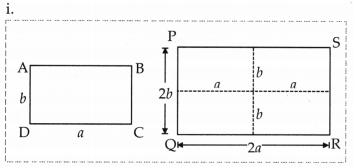
Given:
Rectangle ABCD has sides a, b
Rectangle PQRS has sides 2a, 2b
∵ Area of rectangle = length × breadth
Area of ABCD = a × b = ab ...(i)
Area of PQRS = (2d) (2b) = 4ab ... (ii)
∴ Area of PQRS = 4 × Area of ABCD ...[From (i) and (ii)]
Fitting of rectangles:
∵ PQRS has dimensions 2a and 2b
We can arrange, rectangle PQRS with breadth b with length a as:
- Two rectangles along length 2a
- Two rectangles along breadth 2b
∴ Total rectangles = 2 + 2 = 4
∴ 4 copies of ABCD fit exactly into PQRS
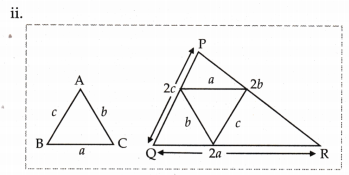
Given:
∆ABC has sides a, b, c
∆PQR has sides 2a, 2b, 2c
For ∆ABC:
∵ Semi perimeter (s) = $\frac{a+b+c}{2}$
Area of ∆ABC = $\sqrt{s(s-a)(s-b)(s-c)}$ ... (i)
For ∆PQR:
∵ Semi perimeter (s') = $\frac{2 a+2 b+2 c}{2}$ = a + b + c = 2s j
Area of ∆PQR
$\begin{aligned} & =\sqrt{s^{\prime}\left(s^{\prime}-2 a\right)\left(s^{\prime}-2 b\right)\left(s^{\prime}-2 c\right)} \\ & =\sqrt{2 s(2 s-2 a)(2 s-2 b)(2 s-2 c)} \\ & =\sqrt{2 s \cdot 2(s-a) \cdot 2(s-b) \cdot 2(s-c)} \\ & =\sqrt{16 \cdot s(s-a)(s-b)(s-c)} \\ & =4 \sqrt{s(s-a)(s-b)(s-c)}\end{aligned}$
∴ Area of ∆PQR = 4 × Area of ∆ABC
Fitting of Triangles:
Divide each side of ∆PQR into 3 equal parts. Join points through lines parallel to the sides.
This divides ∆PQR into 9 smaller triangles.
Each of these smaller triangles: has side lengths equal to one-third of ∆PQR
Hence, sides of each triangle are a, b, c
∴ So, each triangle is congruent to ∆ABC
∴ 9 copies of ∆ABC will fit into ∆PQR.