Try to extend this method for constructing line segments of lengths 3 and 5 Class 9
Try to extend this method for constructing line segments of lengths 3 and 5 Class 9
Question 1.
Try to extend this method for constructing line segments of lengths [latex]\sqrt{3}[/latex] and [latex]\sqrt{5}[/latex] using a ruler and a compass. Generalise this method to construct a line segment of any length of the form [latex]\sqrt{n}[/latex], where n is a positive integer. Class 9
Answer:
For [latex]\sqrt{3}[/latex], first construct a line segment of length [latex]\sqrt{2}[/latex].
At its endpoint, draw a perpendicular of length 1 unit and join the new point to the origin.
The new hypotenuse obtained is [latex]\sqrt{3}[/latex].
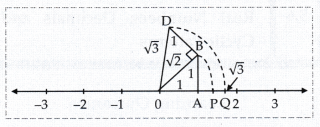
Similarly, for [latex]\sqrt{5}[/latex], first construct a line segment of length [latex]\sqrt{4}[/latex] (that is, 2 units).
At its endpoint, draw a perpendicular of 1 unit and join it to the origin.
The hypotenuse obtained is [latex]\sqrt{5}[/latex].
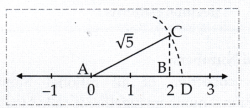
In general, to construct a line segment of length [latex]\sqrt{n}[/latex], first construct a line segment of length [latex]\sqrt{n-1}[/latex].
Draw a perpendicular of 1 unit at its end point and join the new point to the origin. By Baudhayana-Pythagoras Theorem, the hypotenuse obtained will be of length [latex]\sqrt{n}[/latex].
Thus, using a ruler and compass, we can construct any line segment of length [latex]\sqrt{n}[/latex], where n is a positive integer.