Use the Baudhayana-Pythagoras theorem to show why Theorem 6 must be true. Class 9
Use the Baudhayana-Pythagoras theorem to show why Theorem 6 must be true. Class 9
Question 1.
Use the Baudhayana-Pythagoras theorem to show why Theorem 6 must be true. Class 9
Answer:
Given : C is the centre of the circle with radius r. Chord AB = Chord FG.
E and H are the midpoints of AB and FG respectively.
To show : CE = CH
Proof:
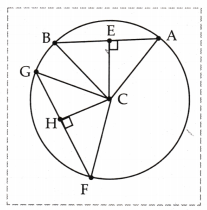
CE ⊥ AB and CH ⊥ FG ... [The line joining the centre and midpoint of a chord of a circle is perpendicular to the chord]
For chord AB,
AE = $\frac{\mathrm{AB}}{2}$ ... [E is the midpoint of AB]
In right-angled ∆CEA,
CA² = CE² + AE²
...[By Baudhayana-Pythagoras theorem]
∴ r² = CE² + $\left(\frac{\mathrm{AB}}{2}\right)^2$ ...(i)
For chord FG,
FH = $\frac{\mathrm{FG}}{2}$ ... [H is the midpoint of GF]
In right-angled ∆CHF,
CF² = CH² + FH²
...[By Baudhayana-Pythagoras theorem]
∴ r² = CH² + $\left(\frac{\mathrm{FG}}{2}\right)^2$ ...(ii)
From (i) and (ii), we get
$\mathrm{CE}^2+\left(\frac{\mathrm{AB}}{2}\right)^2=\mathrm{CH}^2+\left(\frac{\mathrm{FG}}{2}\right)^2$
But, AB = FG ... [Given]
∴ CE² = CH²
∴ CE = CH
Hence, chords of equal length are equidistant from the centre.