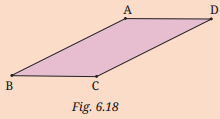
What happens if the parallelogram is "thin" (Fig. 6.18) and the foot of the perpendicular from C to AD Class 9
R
RBSEGuide
What happens if the parallelogram is "thin" (Fig. 6.18) and the foot of the perpendicular from C to AD Class 9
Question 1.
What happens if the parallelogram is "thin" (Fig. 6.18) and the foot of the perpendicular from C to AD does not lie on side AD? The construction then does not seem to work how do we fix this 'gap'? Class 9
Answer:
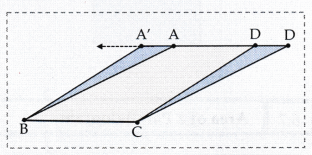
Select a point D' on DA close to D, and a j point A' on DA extended, such that A'A = D'D. Now A'BCD' is a new parallelogram with the same area as ABCD (since ACDD' = ABAA', the piece removed equals the piece added).
Repeat this shifting process as many times as needed.
Each step makes the parallelogram slightly less "thin", until the foot of the j perpendicular finally falls within the base. At that point, the standard cut-and-rearrange construction works normally.