Without performing long division, determine which of the following rational numbers will have terminating decimals Class 9
Without performing long division, determine which of the following rational numbers will have terminating decimals Class 9
Question 1.
Without performing long division, determine which of the following rational numbers will have terminating decimals and which will be repeating: $\frac{7}{20}, \frac{4}{15}$ and $\frac{13}{250}$
Then check your answers by explicitly performing the long divisions and expressing these rational numbers as decimals. Class 9
Solution:
i. $\frac{7}{20}$
20 = 2² × 5
Since the denominator has only prime factors 2 and 5.
∴ $\frac{7}{20}$ is a terminating decimal.
Verification:
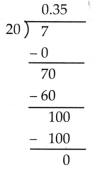
∴ $\frac{7}{20}$ = 0.35
Hence, it is a terminating decimal.
ii. $\frac{4}{15}$
15 = 3 × 5
Since the denominator has a prime factor other than 2 and 5.
∴ $\frac{4}{15}$ is a non-terminating repeating decimal.
Verification:
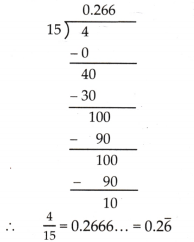
Hence, it is a non-terminating repeating decimal.
iii. $\frac{13}{250}$
250 = 2 × 5³
Since the denominator has only prime factors 2 and 5.
∴ $\frac{13}{250}$ is a terminating decimal.
Verification:
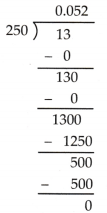
∴ $\frac{13}{250}$ = 0.052
Hence, it is a terminating decimal.