Write the sample space and calculate the probability based on the given information. Class 9
Write the sample space and calculate the probability based on the given information. Class 9
Question 1.
Write the sample space and calculate the probability based on the given information. Class 9
i. Two dice are rolled. What is the probability that the sum is a prime number greater than 5?
ii. A bag contains 4 red, 3 green, and 2 blue balls. Two balls are drawn without replacement. What is the probability that both are of different colours?
iii. Three coins are tossed. What is the probability that the first coin shows heads and exactly two heads occur in total?
iv. A four-digit number is formed using the digits 1, 2, 3, and 4 with no repetition. What is the probability that the number is even?
v. A student takes a multiple-choice test with 3 questions, each having 4 options (A, B, C, D), with only one correct answer. What is the probability that the student guesses and gets exactly 2 answers correct?
Solution:
i. Sample space
S = {(1, 1), (1, 2), (1, 3), (1, 4), (1, 5), (1, 6),
(2, 1), (2, 2), (2, 3), (2, 4), (2, 5), (2, 6),
(3, 1), (3, 2), (3, 3), (3, 4), (3, 5), (3, 6),
(4, 1), (4, 2), (4, 3), (4, 4), (4, 5), (4, 6),
(5, 1), (5, 2), (5, 3), (5, 4), (5, 5), (5, 6),
(6, 1), (6, 2), (6, 3), (6, 4), (6, 5), (6, 6)}
Total number of outcomes = 6 × 6 = 36
Prime numbers greater than 5 = 7, 11
For sum = 7: (1, 6), (2, 5), (3, 4), (4, 3), (5, 2), (6, 1)
For sum = 11 : (5, 6), (6, 5)
∴ Number of favourable outcomes = 6 + 2 = 8
P(sum is prime number greater than 5) = $\frac{\text { Number of favourable outcomes }}{\text { Total number of outcomes }}=\frac{8}{36}=\frac{2}{9}$
ii. Let Red = R, Blue = B, Green = G
Total Number of balls = 4 + 3 + 2 = 9
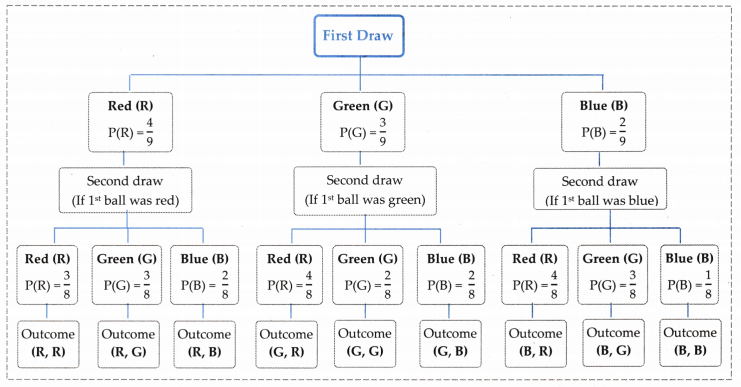
P(Both balls of different colours)
P(R, G) + P(R, B) + P(G, R) + P(G, B) + P(B, R) + P(B, G)
$\begin{aligned} & =\frac{4}{9} \times \frac{3}{8}+\frac{4}{9} \times \frac{2}{8}+\frac{3}{9} \times \frac{4}{8}+\frac{3}{9} \times \frac{2}{8}+\frac{2}{9} \times \frac{4}{8}+\frac{2}{9} \times \frac{3}{8} \\ & =\frac{12}{72}+\frac{8}{72}+\frac{12}{72}+\frac{6}{72}+\frac{8}{72}+\frac{6}{72}=\frac{52}{72}=\frac{13}{18}\end{aligned}$
iii. Sample space : S = {HHH, HHT, HTH, HIT, THH, THT, TTH, TTT}
Total number of outcomes = 8
Favourable outcomes : {HHT, HTH}
Number of favourable outcomes = 2
∴ P(1st heads and exactly two heads)
$=\frac{\text { Number of favourable outcomes }}{\text { Total number of outcomes }}=\frac{2}{8}=\frac{1}{4}=0.25$
iv. 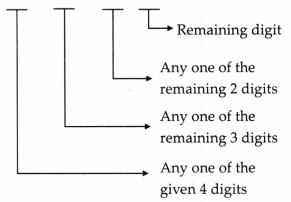
∴ Total number of 4 digit numbers
= 4 × 3 × 2 × 1 = 24
For number to be even,
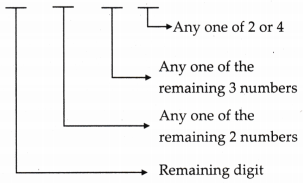
∴ Number of even numbers = 2 × 3 × 2 × 1 = 12
P(even number)
$=\frac{\text { Number of favourable outcomes }}{\text { Total number of outcomes }}=\frac{12}{24}=\frac{1}{2}=0.5$
v. Let C = Correct answer and
W = Wrong answer
For each question:
P(correct answer) = P(C) = $\frac{1}{4}$
P(wrong answer) = P(W) = $\frac{3}{4}$
For exactly two correct answers,
Sample space = {CCW, CWC, WCC}
∴ P(exactly two correct answers)
= P(C) × P(C) × P(W) + P(C) × P(W) × P(C) + P(W) × P(C) × P(C)
$\begin{aligned} & =\frac{1}{4} \times \frac{1}{4} \times \frac{3}{4}+\frac{1}{4} \times \frac{3}{4} \times \frac{1}{4}+\frac{3}{4} \times \frac{1}{4} \times \frac{1}{4} \\ & =3 \times \frac{3}{64}=\frac{9}{64}\end{aligned}$