You know that the area of a parallelogram is base × height. Using this and the figure, show that the area Class 9
You know that the area of a parallelogram is base × height. Using this and the figure, show that the area Class 9
Question 1.
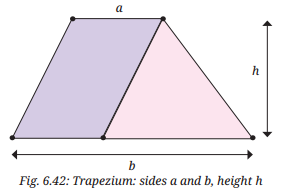
You know that the area of a parallelogram is base × height. Using this and the figure, show that the area of a trapezium is half the sum of the parallel sides × height, i. e., $\frac{1}{2}$(a + b)h Class 9
Solution:
Given: In Trapezium.
Length of Parallel sides = a, b, height = h
To prove:
Area of trapezium = $\frac{1}{2}$(a + b)h
Proof:
Trapezium ABCD is divided into two parts.
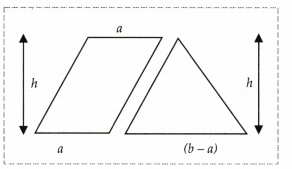
i. a parallelogram (left part)
ii. a triangle (right part)
In parallelogram,
Base = a, height = h
∴ Area of parallelogram = a × h ...(i)
In triangle
∵ Base = (b - a), height = h
∴ Area of triangle = $\frac{1}{2}$(b - a)h ... (ii)
∵ Area of trapezium = Area of parallelogram + Area of triangle
$=a h+\frac{1}{2}(b-a) h \quad \ldots[$ From (i), (ii) $]$
$\begin{aligned} & =\frac{2 a h+(b-a) h}{2} \\ & =\frac{(2 a+b-a) h}{2} \\ & =\frac{(a+b) h}{2}\end{aligned}$
∴ Area of trapezium = $\frac{1}{2}$(a + b)h i.e., half the sum of parallel sides × height