A ball rolls down an inclined track as shown in Fig. Is its motion, a straight line motion? Class 9
A ball rolls down an inclined track as shown in Fig. Is its motion, a straight line motion? Class 9
Question 1.
A ball rolls down an inclined track as shown in Fig. Is its motion, a straight line motion? Assuming the starting point of the ball (O) to be the origin, can its motion from O to D be depicted using a horizontal line as shown in Fig.? Are the values of total distance travelled and magnitude of displacement from O equal or different at positions A, B, C and D? Class 9
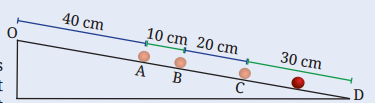
Fig. A ball rolling down an inclined track
Answer:
Yes, the motion of the ball is along a straight line (along the inclined track). Its motion from O to D can be represented using a horizontal line by taking positions along the track as distances from the origin. The values of total distance travelled and magnitude of displacement from O are equal at positions A, B, C, and D because the motion is along a straight line in one direction.
(Page 53)
Question 2.
During a family road trip, you drive 200 km north in three hours. Afterwards, you drive 200 km south in two hours. Find the average speed and average velocity for your entire trip. Class 9
Answer:
Given:
- First part: 200 km North in 3 hours
- Second part: 200 km South in 2 hours
Step 1: Calculate total distance travelled
Total distance = 200 km + 200 km = 400 km
Step 2: Calculate total time
Total time = 3 hours + 2 hours = 5 hours
Step 3: Calculate average speed
Average speed = total distance / total time = 400 km / 5 h = 80 km h-1
Step 4: Calculate displacement
You travel 200 km North, then 200 km South - you return to your starting point. Net displacement = 200 km North - 200 km South = 0 km
Step 5: Calculate average velocity
Average velocity = displacement / total time = 0
km / 5 h = 0 km h-1