A researcher carried out an experiment in which she took two carrots of similar size. Class 9
A researcher carried out an experiment in which she took two carrots of similar size. Class 9
Question 1.
A researcher carried out an experiment in which she took two carrots of similar size. She placed one carrot in plain water and the other carrot in concentrated salt solution (Fig.). After 24 hours she recorded her observations. Class 9
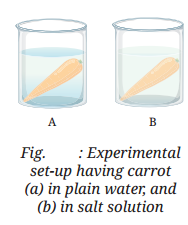
(i) What hypothesis does she want to test through this experiment?
Answer:
The researcher wants to test that water moves in and out of cells through osmosis depending on the concentration of the surrounding solution.
(ii) What would you suggest for the improvement of this experiment?
Answer:
- Use carrots of equal size and weight for accurate comparison
- Measure and record the initial and final weight of carrots
- Keep all other conditions (time, temperature, amount of solution) constant
- Repeat the experiment to ensure reliable results
(iii) Why does the carrot in plain water stay stiff and crunchy, but the carrot in concentrated salt solution become rubbery and limp?
Answer:
- In plain water (hypotonic solution): Water enters the carrot cells by osmosis, making the cells turgid (firm). So, the carrot remains stiff and crunchy
- In concentrated salt solution (hypertonic solution): Water moves out of the carrot cells, causing them to lose water and shrink. So, the carrot becomes rubbery and limp.
Conclusion: The experiment demonstrates osmosis, where water moves across a selectively permeable membrane based on concentration differences.