Activity 4.1 Let us analyse the motion of a ball thrown vertically upwards. Class 9
Activity 4.1 Let us analyse the motion of a ball thrown vertically upwards. Class 9
Activity 4.1 Let us analyse
Aim: To analyse the motion of a ball thrown vertically upwards and understand the difference between total distance travelled & displacement.
Question 1.
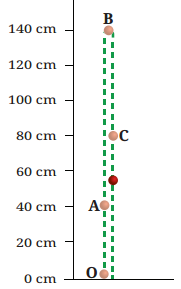
A ball is thrown vertically upwards from O. It moves up straight till B and then falls back to O. Can this be considered a motion in a straight line? Class 9
Answer:
A ball in vertical motion (two separate lines are shown only for clarity; in reality, the object goes up and falls back in the same straight line)
Question 2.
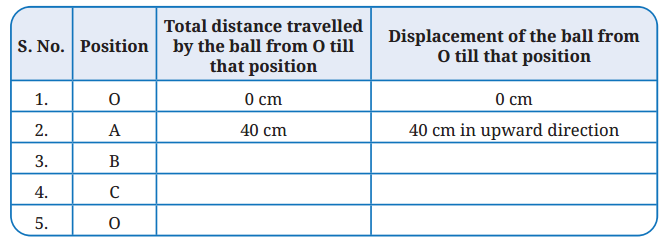
For this motion, fill up the values in Table 4.1. Class 9
Table 4.1: Distance travelled and displacement of the ball
Answer:
| S. No. | Position | Total distance travelled by the ball from O till that position | Displacement of the ball from O till that position |
| 1. | 0 | 0 cm | 0 cm |
| 2. | A | 40 cm | 40 cm in upward direction |
| 3. | B | 140 cm | 140 cm in upward direction |
| 4. | C | 140 cm + (140 - 70) cm = 210 cm | 70 cm in upward direction |
| 5. | 0 | 280 cm | 0 cm |
(Note: From the figure, 0 is at 0 cm, A is at 40 cm, B is at 140 cm, C is at 70 cm on the way down. The ball travels up to B = 140 cm, then falls back. At C it has fallen 70 cm from B,
so distance = 140 + 70 = 210 cm; displacement = 140 - 70 = 70 cm upward.
Question 3.
Analyse the data filled in Table and choose which of the following is true for displacement: Class 9
(i) It is never zero.
(ii) Its magnitude can be greater than the total distance travelled.
(iii) Its magnitude is less than or equal to the total distance travelled.
(iv) Its magnitude is less than the total distance travelled in all cases.
Observation: Table: Distance travelled and displacement of the ball
Answer:
(iii) Its magnitude is less than or equal to the total distance travelled.
Yes, this can be considered motion in a straight line because the ball moves only along a vertical straight line - upward and then downward - throughout its entire journey.
Observation: Distance is the total path length covered by the object, regardless of direction. It is always positive and keeps increasing. Displacement is the net change in position - it has both magnitude and direction. When the ball returns to its original position 0, the displacement becomes zero even though a large distance has been covered. This shows that displacement can be zero while distance is not, and the magnitude of displacement is always less than or equal to the total distance travelled. They are equal only when the object moves in one direction without reversing.
This activity demonstrates the difference between distance and displacement, and confirms that displacement is a vector quantity while distance is a scalar quantity.
Conclusion: It is a motion in straight line. Magnitude of displacement is less than or equal to the total distance travelled.