Activity 3.1 Let us design experiment, Apical Meristem causes growth in length. Class 9
Activity 3.1 Let us design experiment, Apical Meristem causes growth in length. Class 9
Activity 3.1 Let us design experiment
Aim: Apical Meristem causes growth in length.
Materials Required: Two glass jars, two onion bulbs, scale, scissors or scalpel, water.
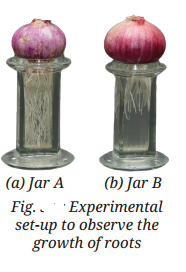
Procedure:
- Take two glass jars. Fill them with water.
- Place an onion bulb over the mouth of each jar in such a way that stem base of the bulb dips in water.
- Observe daily. Roots develop from the base of the bulbs in both the jar. Measure the length of the roots daily.
- On fourth day, remove 1 cm long apical portion of the roots of bulb.
- Measure the lengths of the roots in both the bulbs on fifth and sixth day.
Observation:

(Note: Root tips of Jar B Are cut on Day 3. Values are representative /approximate)
- Roots in Jar A continue to grow steadily in length throughout all 7 days.
- Roots in Jar B grow at a similar rate to Jar A on Days 1, 2 and 3, but stop growing completely after the root tips are cut on Day 3.
- The graph of Jar A shows a continuously rising straight line, while Jar B shows a flat plateau from Day 3 onwards.
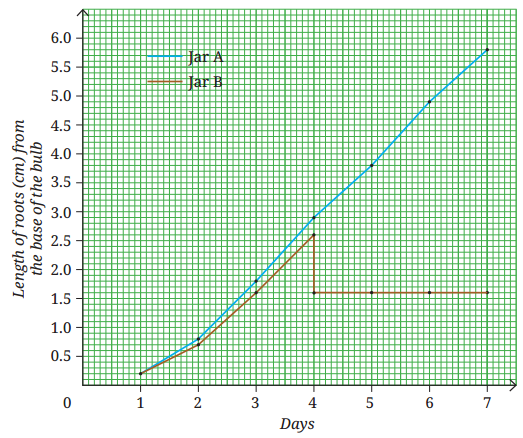
Explanation: Roots grow only from their tips. The root tips consist of cells which divide continuously. These actively dividing cells at the tip form the apical meristem. When the tips of the roots in Jar B are cut, the apical meristematic tissue is removed and the roots can no longer grow in length. The roots in Jar A, with tips intact, continue to grow. This confirms that plants have growth zones at the tips of their roots and shoots, called the apical meristems, which help the plants grow in length.
Conclusion: This activity demonstrates the role of apical meristematic tissue in the lengthwise growth of plant roots.