Activity 11.3 Let us experiment to study growth of bread mould, fungus (Rhizopus). Class 9
R
RBSEGuide
Activity 11.3 Let us experiment to study growth of bread mould, fungus (Rhizopus). Class 9
Activity 11.3 Let us experiment
Aim: To study growth of bread mould, fungus (Rhizopus).
Materials Required: Moist slice of bread or a roti, petridish and magnifying glass.
Procedure:
- Take a small slice of bread or a roti and lightly moisten it with a few drops of water.
- Using a plastic box or steel dabba, Prepare a moist chamber placing a thin layer of cotton in it.
- Moisten it with boiled water, keep the bread or roti on it and cover it with tissue paper.
- Keep the moist chamber in a warm and dark place, away from direct sunlight.
- Observe the bread or roti every day for any changes. Record your observations without touching it directly.
- Record the changes after three days, you will notice enough mould grows on it.
- Carefully take the box to the school laboratory and with the help of needle transfer onto a microscope slide.
- Under the guidance of your teacher, add cotton blue stain—a coloured dye to help see it better.
- Observe the mould under the microscope and draw its diagram based on your observations.
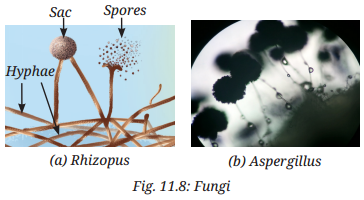
- Compare the diagram you have drawn with Fig. and share your observations with your classmates.
Observation:
- The bread slice will be covered by a white cutting mass due to growth of bread mould which is the mycelium of rhizopus as in fig (a).
- After few days, it turns black, i.e., the vegetative mycelium develops into asexual sporangia as in fig (b).
Conclusion: Each sporangia contains hundred of black spores and these spores are dispersed into air to germinate on suitable substratum.