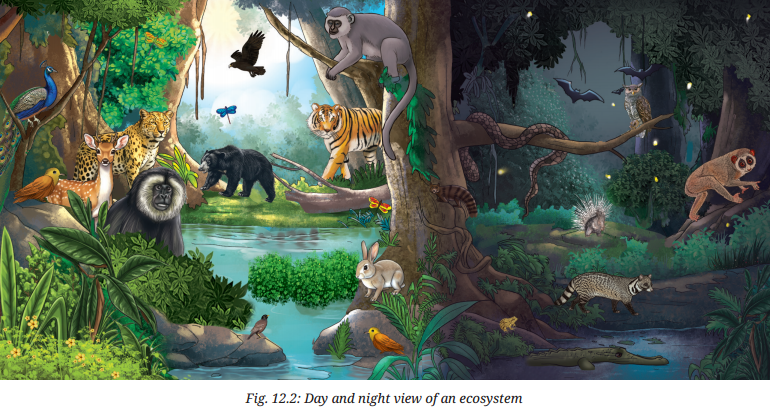
Activity 12.1 Let us compare and classify Fig. shows the diversity of animals in an ecosystem. Class 9
Activity 12.1 Let us compare and classify Fig. shows the diversity of animals in an ecosystem. Class 9
Activity 12.1 Let us compare
Let us compare and classify Fig. shows the diversity of animals in an ecosystem.
Aim: Observe the image carefully. Can you guess how the organisms are grouped in the image?
Question 1.
Ponder on the questions given below: Class 9
Which animals can you identify in the given picture?
Answer:
We may identify animals such as tiger, leopard, bear, eagle, owl, bat, rabbit, monkey, peacock, deer, snake, and fish-like organisms in and around the water body.
Where are they seen?
Answer:
These organisms are seen in different habitats such as:
Air: Eagle, owl, bat, dragonfly, firefly and other birds are seen flying in the air.
Land (terrestrial habitat): Tiger, leopard, deer, rabbit, bear, langur, raccoon, lion-tailed macaque, hedgehog, and peacock live on land, mainly in forests and grasslands.
Water (Aquatic habitat): Crocodile and frog spend most of their time in or near water bodies like rivers, lakes, and ponds.
Both land and water (amphibious/semi-aquatic): Frog and crocodile can live both on land and in water.
Trees (arboreal habitat): Langur, loris, and lion-tailed macaque are mostly found on trees.
Ground/under bushes: Snake and some small animals like hedgehog live on the ground or under bushes.
Which animals in the picture seem active:
(i) during the day?
Answer:
Animals active during the day (Diurnal): Eagle, tiger, peacock, deer, rabbit, and monkey appear active during the day.
(ii) during the night?
Answer:
Animals active during the night (nocturnal): Owl and bat appear active during the night.
(iii) both during the day and the night?
Answer:
Animals active during both day and night: Leopard, snake, frog, crocodile, bear, rabbit and some insects may be active both during the day and the night.
Question 2.
Record your observations in Table 1. Now, try grouping the same organisms in more than one way. Each time change the criterion you are using for grouping (Table 2). Class 9
Observation - Table 1:
| Organism (draw or write name) | Where do you see it? (flying high in air/flying near the ground/tree/ water/forest floor) | When does it appear to be active? (day/night/unsure) | Any visible feature(s) |
| Owl | Tree | Night | Feathers, large eyes |
| Tiger | Forest floor | Night | Stripes, four legs |
| Eagle | Flying high in air | Day | Wings, sharp beak, talons |
| Rabbit | Ground | Day | Long ears, fur |
| Monkey | Tree | Day | Long tail, hands for gripping |
| Bat | Flying near ground | Night | Wings, no feathers |
| Deer | Forest floor | Day | Antlers, hooves |
| Snake | Ground/forest floor | Day | Scales, no legs |
| Peacock | Ground/flying near ground | Day | olourful feathers, crest |
| Fish/fish-like organism | Water | Unsure | Fins, scales |
Grouping the organisms - Table 2:
| The grouping criterion | Which organisms fit in this group? | What feature or pattern helped you decide? |
| Carnivore | Eagle, tiger, leopard | Eating habits - feed on other animals |
| Herbivore | Deer, rabbit | Eating habits - feed on plants |
| Has feathers | Eagle, peacock, owl | Body covering |
| Nocturnal (active at night) | Owl, bat, tiger | Activity pattern |
| Diurnal (active during day) | Eagle, rabbit, deer, peacock | Activity pattern |
| Lives on trees | Monkey, owl | Habitat |
| Has four legs | Tiger, deer, rabbit, monkey | Body structure/external features |
| Can fly | Eagle, owl, bat, peacock | Mode of locomotion |