Activity 3.3 Let us perform, To identify different connective tissues in the human body. Class 9
R
RBSEGuide
Activity 3.3 Let us perform, To identify different connective tissues in the human body. Class 9
Activity 3.3 Let us perform
Aim: To identify different connective tissues in the human body through daily simple life actions and undersatand their functions.
Procedure:
- Study their functions and identify the connective tissues.
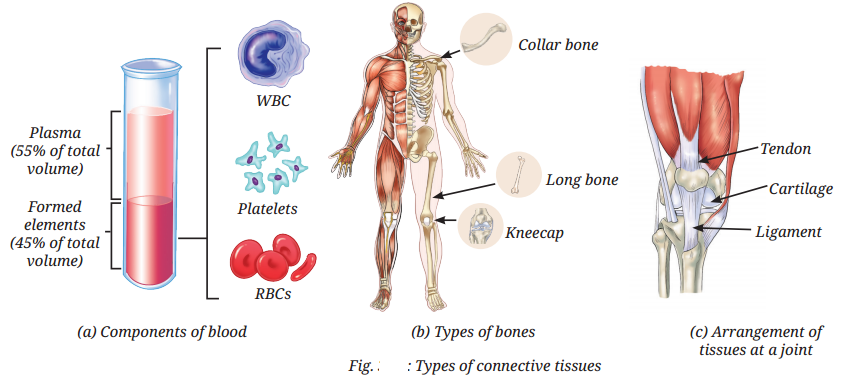
Table: Your experiences, observations and questions from daily life
| Action | Experience | Function | Identified connective tissue |
| Touch your elbow gently | A hard and rigid structure | Gives strength, support and protection | Bone [Fig (b)] |
| Press and fold your ear or gently press your nose and stop | A soft and flexible structure that retains shape again | Provides flexibility and cushions the ends of bones for shock absorption | Cartilage [Fig (c)] |
| Touch your forearm muscles and wiggle your fingers | Feel movement in the forearm even though fingers are far away | Connects muscle to bone, and thus, brings about movement | Tendon [Fig (c)] |
| Sit on a chair and move your leg upwards till your knee allows | The joint does not go beyond a limit | Connects bone to bone and provides stability, limits movement, and helps prevent dislocation | Ligament [Fig (c)] |
Observation:
- Touching the elbow feels hard and rigid, indicating the presence of bone, which provides structural strength and protection to the body.
- The ear and nose feel soft and flexible, and return to their original shape when released, indicating the'presence of cartilage, which provides cushioning and flexibility.
- Touching the forearm muscles while wiggling fingers shows that movement is transmitted from the muscles even to distant parts, indicating the role of tendons in connecting muscles to bones.
- The knee joint stops movement at a fixed limit, indicating the role of ligaments in connecting bones and preventing excessive or dislocating movement.