Activity 4.4 Let us calculate the average velocity of a moving vehicle from its position. Class 9
R
RBSEGuide
Activity 4.4 Let us calculate the average velocity of a moving vehicle from its position. Class 9
Activity 4.4 Let us calculate
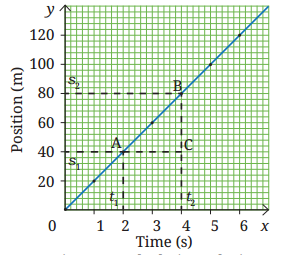
Aim: To calculate the average velocity of a moving vehicle from its position-time graph by finding the slope of the line.
Observation:
We select two point on the line, A and B. By drawing line parallel to the axes, we form right-angled triangle ABC.
- Side BC: Represents the change in position (s2 - sa). Look is 80m - 40m = 40m.
- Side AC: Represents the change in time (t2 - 11). Looking 4s - 2s = 2s.
Average velocity (v) is defined as the rate of change of position. Using the values extracted from the graph:
v = [latex]\frac{\mathrm{s}_2-\mathrm{s}_1}{\mathrm{t}_2-\mathrm{t}_1}[/latex] = [latex]=\frac{\mathrm{BC}}{\mathrm{CA}}[/latex] = [latex]\frac{80-40}{4-2}[/latex] = 20 m/s-1
Conclusion:
The most important takeaway from the activity is the geometric interpretation of the graph.
- The ratio BC/AC is called the solope of the line, the slope equals the velocity and if the line is steeper, it means the object is moving faster. If the line is horizontal, the slope is 0, meaning the object is at rest.