Activity 5.1 To identify whether the given mixtures are a true solution. Class 9
R
RBSEGuide
Activity 5.1 To identify whether the given mixtures are a true solution. Class 9
Activity 5.1
Aim: To identify whether the given mixtures are a true solution, a suspension, or a colloid.
Materials Required: Two glass beakers, Water, Salt or sugar, Sand, Spoon
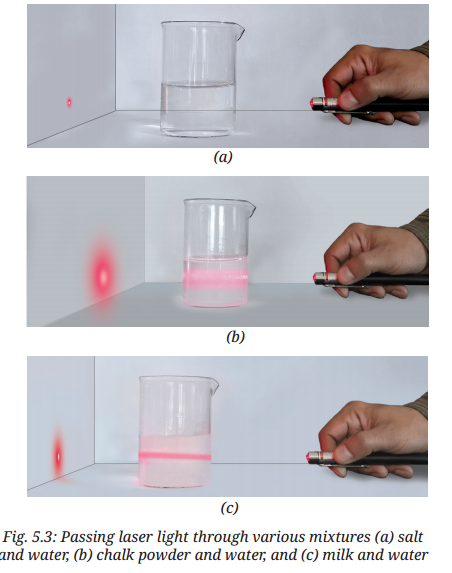
Procedure:
- Take three beakers and label them (a), (b) and (c).
- In Beaker (a), add water and mix some salt (or sugar). Stir well
- In Beaker (b), add water and mix chalk powder. Stir it.
- In Beaker (c), add milk with water. Stir it.
Observation:
Beaker (a) (Salt + Water):
- Appears clear and uniform.
- No visible particles to the naked eyes.
- The path of the laser beam is visible.
- Salt completely dissolves
Beaker (b) (Chalk powder + Water):
- Appears cloudy or non-uniform,
- Sand particles are clearly visible,
- Sand settles at the bottom, so the path of the laser beam is visible.
Beaker (c) (Milk + Water):
- Appears cloudy and uniform.
- No visible particles to the naked eyes.
- The path of the laser beam is visible (Tyndall Effect).
- On standing, particles do not settle.
Conclusion:
- Homogeneous mixture: Uniform composition (salt + water)
- Heterogeneous mixture: Non-uniform composition (chalk power + water)
- Appears Homogeneous mixture: Shows Tyndall effect, does not settle, (milk + water)
This activity shows that mixture differ based on particle size, visibility, stability and light scattering properties.