Activity 2.5 Let us enhance our skills, To study the structure of activity dividing cells. Class 9
Activity 2.5 Let us enhance our skills, To study the structure of activity dividing cells. Class 9
Activity 2.5 Let us enhance our skills
Aim: To study the structure of activity dividing cells in the onion root tip and observe different stages of mitosis under a microscope.
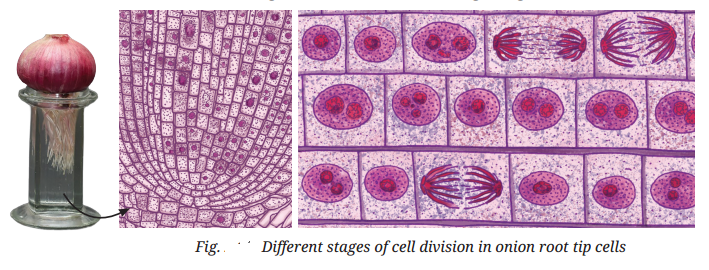
Procedure:
- Take a jar and fill it up with plain water.
- Now, place an onion bulb over the jar in such a way that its base, bearing roots, is immersed in the water.
- Leave the setup for 5-6 days and observe. Do you observe the roots growing? Cut 2-3 cm of the freshly grown roots and transfer them to freshly prepared aceto-alcohol (glacial acetic acid: ethanol:: 1:3). Keep the root tips in aceto-alcohol for 24 hours and then transfer them to 70 per cent ethanol (for preservation).
- Take one or two preserved roots, wash them in water and then place them on a clean slide.
- Put one drop of dilute Hydrochloric acid (HCl) on the root tips to soften the tissue. Rinse the roots after 10-15 minutes. Then add 2-3 drops of aceto-carmine stain on them.
- Leave the slide for 5-10 minutes and then, gently warm it (with caution) over a spirit lamp.
- Cut the tip portion of the root on the slide and put a coverslip. Gently squash the coverslip with your thumb to spread the cells on the slide.
- Observe the slide under a microscope.
Observations: The onion root tip shows a large number of actively dividing cells. Cells are small, closely packed and actively growing in the meristematic region. Different stages of mitosis can be clearly observed.
- Interphase: Nucleus is distinct; chromatin network is visible.
- Prophase: Chromosomes become short, thick and visible.
- Metaphase: Chromosomes align at the centre (equatorial plate).
- Telophase: Two new nuclei form; cell begins to divide.
The chromosomes appear darkly stained due to acetocramine stain, making them clearly visible under the microscope. The highest number of cells is usually seen in interphase, while anaphase and telophase stages are less frequently observed.
Conclusion: The onion root tip consists of a rapidly dividing meristematic region where cells undergo mitosis continuously. Mitosis produces two genetically identical daughter cells, ensuring growth and repair in plants while maintaining the same chromosome number. Hence, the root tip is an ideal region to study different stages of mitotic cell division.