Activity 7.5 Let us experiment to verify the law of levers using a beam balance with coins. Class 9
R
RBSEGuide
Activity 7.5 Let us experiment to verify the law of levers using a beam balance with coins. Class 9
Activity 7.5 Let us experiment
Aim: To verify the law of levers using a beam balance with coins.
- Take a long scale (50 cm or larger), a piece of string, two paper cups (to act as pans), adhesive tape or a piece of thread and identical coins (to act as weights).
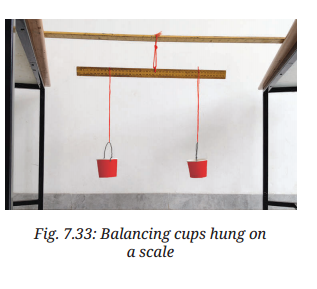
- Tie the string tightly around the scale at its midpoint. This string will act as the fulcrum. Hang the scale from this string using a stand or hook, so that it can swing freely. This scale will now act as a beam (Fig.).
- Fix paper cups to both ends of the beam using thread. These cups act as the pans of a balance. Check whether the beam is levelled. If it is tilted, adjust the hanging points of the pans until both sides balance equally.
- Place 1 coin in the left pan (call it effort) and 1 identical coin in the right scale pan (call it load). Observe that the beam stays horizontal.
- Add one more coin to the right pan, so that it contains 2 coins. The beam tilts. Move the heavier pan closer to the centre of the beam to balance the beam. Measure its distance from the centre.
- Repeat step 5 with 4 coins and then 8 coins in the right pan. Each time, note its distance from the centre that balances the beam.
- Record all observations and measurements, and complete the Table by adding more rows.
Observation:
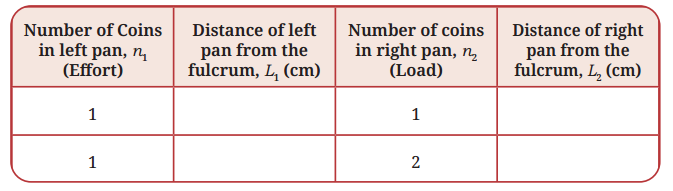
Table: Number of coins in the left pan and its distance from the fulcrum
Result:
| Number of Coins in left pan, n1 (Effort) | Distance of left pan from the fulcrum, L1 (cm) | Number of Coins in right pan, n2 (Load) | Distance of right pan from the fulcrum, L2 (cm) |
| 1 | L1 | 1 | L1 (equal) |
| 1 | 2L1 | 2 | L1 |
Calculation:
The beam balances when n1 × L1 = n2 × L2
or, effort × effort arm = load × load arm
Thus, Mechanical advantage = [latex]\frac{\text { Load }}{\text { Effort }}[/latex] = [latex]\frac{\text { effort arm }}{\text { load arm }}[/latex]
Conclusion:
Hence, by increasing the effort arm, the lever applies a larger force F2 to the load than the effort F1. The lever thus allows us to gain a mechanical advantage equal to the ratio of the distances, i.e., = L1.