Activity 9.2 To investigate whether mass is conserved during a chemical change. Class 9
Activity 9.2 To investigate whether mass is conserved during a chemical change. Class 9
Activity 9.2
(A) Experimental Set-up 1
Aim: To investigate whether mass is conserved during a chemical change in an open setup (reaction between vinegar and baking soda).
Procedure: When baking soda (sodium hydrogen bicarbonate) is added to vinegar, carbon dioxide gas is formed during the chemical change. Pour 20 ml of vinegar in a beaker. Take 2 g of baking soda and put it in the balloon.
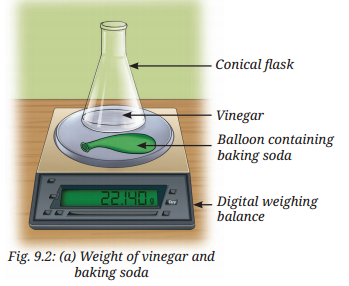
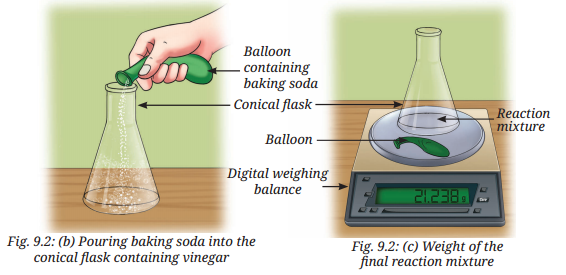
Measure the weight of balloon filled with baking soda and vinegar filled beaker on the weighing balance. Transfer baking soda from the balloon into vinegar filled beaker. Measure the weight of balloon and beaker on the weighing balance. A brisk effervescence is noted and there is mass difference between initial and final weights because carbon dioxide gas produced by the chemical reaction escapes resulting in difference between the initial and final readings.
Conclusion: The mass appears to decrease because the gas produces escapes from the system.
(B) Experimental Set-up 2
Aim: To verify the law of conservation of mass during a chemical reaction in a closed setup (reaction between vinegar and baking soda).
Procedure: Pour 20 ml of vinegar in conical flask. Take 2 g of baking soda and put it in the balloon. Fix the balloon to the mouth of conical flask with a thread without mixing baking soda with vinegar. Weight the conical flask containing vinegar and balloon filled with baking soda. Lift the balloon upwards allowing baking soda to fall into vinegar filled conical flask.
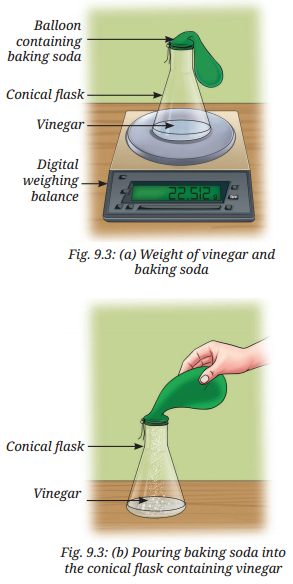
Observation: A brisk effervescence occurs which inflates the balloon and measure the final weight. There is no mass difference between initial and final weights because total mass of vinegar and baking soda before the chemical reaction is equal to total mass of carbon dioxide gas and other substance produced after the chemical reaction.
Conclusion: The total mass before and after the reaction remains constant because the system is closed and no substance escapes. This activity shows that mass is conserved in a chemical reaction when it takes place in a closed system.