Answer the following questions with the help of the data given in table. Class 9
Answer the following questions with the help of the data given in table. Class 9
Question 1.
Answer the following questions with the help of the data given in table. Class 9
Table 5.4: Solubility of various salts (in g per 100 g of water) at different temperatures
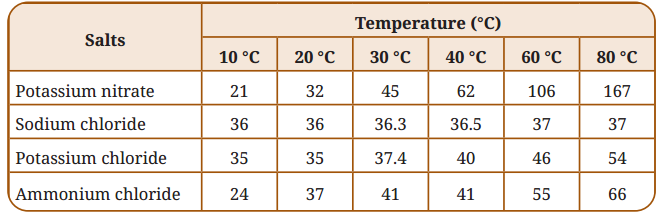
(i) What mass of potassium nitrate would be needed to prepare its saturated solution in 50 g of water at 40 °C?
(ii) A student makes a saturated solution of potassium chloride in water at 80 °C and leaves the solution to cool at room temperature (25 °C). What would she observe as the solution cools? Explain.
(iii) What is the effect of a change in temperature on the solubility of salts? Also, compare the changes in the solubility of the four given salts with increasing temperature from 10 °C to 80 °C.
Answer:
(i) From the table, the solubility of potassium nitrate at 40°C = 62 g per 100 g of water.
For 50 g of water: Mass of potassium nitrate
= ([latex]\frac{62}{100}[/latex]) × 50 = 31 g
So 31 g of potassium nitrate is needed to make a saturated solution in 50 g of water at 40°C.
(ii) At 80°C, the solubility of potassium chloride is 54 g per 100 g water. At 25°C, solubility is approximately 35 g per 100 g water (interpolating from the table between 20°C and 30°C values). As the solution cools from 80°C to 25°C, the solubility drops from 54 g to about 35 g. The extra potassium chloride (54 - 35 = 19 g per 100 g water) that can no longer remain dissolved will crystallise out. The student would observe white crystals of potassium chloride forming and settling at the bottom of the beaker.
(iii) Effect of temperature: The solubility of all four salts increases with an increase in temperature (for solid solutes in liquid solvents).
Comparison:
Potassium nitrate: Most dramatic increase-from 21 g at 10°C to 167 g at 80°C. Solubility increases very rapidly with temperature.
Sodium chloride: Least change - from 36 g at 10°C to 37 g at 80°C. Solubility is nearly constant, barely affected by temperature.
Potassium chloride: Moderate increase -from 35 g at 10°C to 54 g at 80°C. Steady increase with temperature.
Ammonium chloride: Significant increase - from 24 g at 10°C to 66 g at 80°C. Considerable increase with temperature.
Order of increase in solubility with temperature (least to most): Sodium chloride < Potassium chloride < Ammonium chloride < Potassium nitrate.