Changes Around Us Physical and Chemical Class 7 Notes
hard
R
RBSEGuide
Expert Answer
Changes Around Us Physical and Chemical Class 7 Notes
Changes Around Us Physical and Chemical Class 7 Notes
- Inflate: Increase (something) by a large or excessive amount.
- Chemical reaction: The processes by which chemicals interact to form new chemical substances with different compositions.
- Chemical equation: A way to represent a chemical reaction using element symbols or names.
- Infer: To deduce or conclude something from evidence.
- Combustion: A chemical reaction in which a substance reacts with oxygen and produces heat and/or light.
- Extinguished: To put out a fire, flame or light, etc.
- Fireflies: Insects emitting light in late evenings.
- Bioluminescence: The production of light in living organisms.
- Magnifying glass: A special glass used to make an object look larger than it is.
- Ignition temperature: Minimum temperature at which a substance catches fire.
- Vapourisation: The process where a liquid or solid substance changes into a gaseous state, or vapour.
- Reversed: To change the direction, order, position, result, etc.
- Desirable: Having good or pleasing qualities.
- Weathering: The physical and chemical changes in rocks.
- Erosion: When rock pebbles, soil, and sediments are broken down and moved from one location to another by natural forces like wind and flowing water.
- Exothermic: To give off heat.
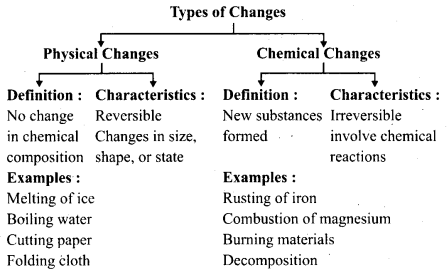
Types of Changes:
- Physical Changes and Chemical Changes
Physical Changes:
- Definition: Changes in which only physical properties like shape, size, and state of substances change.
- Characteristics: Usually reversible, involve changes in size, shape, or state.
- Examples: Melting of ice, boiling water, cutting paper, folding a handkerchief.
Chemical Changes:
- Definition: Changes in which one or more new substances are formed.
- Characteristics: Usually irreversible, involve chemical reactions.
- Examples: Rusting of iron (formation of iron oxide), combustion of magnesium (formation of magnesium oxide).
Rusting:
- Process: Iron reacts with air (oxygen) and moisture to form rust (iron oxide).
- Significance: A common example of a chemical change that can weaken the structures.
- Combustion: Heat and/or light.
- Example: Burning of magnesium ribbon to form magnesium oxide.
- Requirements for combustion: A combustible substance (fuel), Oxygen and ignition temperature
Physical vs. Chemical Changes:
Physical Changes:
- Do not produce new substances.
- Examples: Melting, freezing, dissolving.
- Chemical Changes: Produce new substances.
- Examples: Rusting, burning, decomposition.
Ignition Temperature:
- Definition: The minimum temperature at which a substance catches fire.
- Importance: Understanding ignition temperature helps in fire safety and combustion processes.
- Slow Natural Changes: Examples of natural processes that involve physical and chemical changes, such as soil formation from rocks due to weathering and Erosion.
Comparisons
- Physical: No new substance formed
- Chemical: New substance formed
Additional Concepts:
Rusting
Iron + Oxygen + Moisture → Rust (Iron Oxide) Weakens structures
Combustion
- Burning of substances → Heat and/or Light
- Example: Magnesium ribbon ⟶ Magnesium Oxide
→ Requirements:
Fuel (combustible substance)
Oxygen
Ignition temperature
→ Ignition Temperature
Minimum temperature needed to start combustion
Important for fire safety
→ Slow Natural Changes
Weathering of rocks into soil
Involve both physical and chemical changes
Soil erosion