Identify the separation technique marked as ‘S’. Label the apparatus A, B and C. Class 9
Identify the separation technique marked as ‘S’. Label the apparatus A, B and C. Class 9
Question 1.
Examine fig.
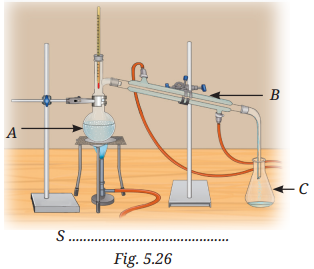
(i) Identify the separation technique marked as ‘S’.
(ii) Label the apparatus A, B and C.
(iii) Which of the following mixtures can be separated by the technique identified above? Use the data given in Table 5.5. Mixtures:
(a) water — acetone
(b) water — salt
(c) acetone — alcohol
(d) sand — salt
(e) alcohol — chloroform
(f) alcohol — benzene

Answer:
(i) The separation technique marked as 'S’ is Distillation. This is indicated by the distillation flask, thermometer, condenser, and collection flask visible in the figure.
(ii) A = Distillation flask (where the mixture is heated).
B = Water condenser (where vapour is cooled back to liquid).
C = Conical flask (where the distillate - the purified liquid - is collected).
(iii) Distillation works when liquids are miscible and differ in boiling points by at least about 25°C.
(a) Water (100°C) and acetone (56°C): Difference = 44°C > 25°C. CAN be separated by distillation.
(b) Water and salt: Salt is a solid. Water can be distilled away from salt solution. CAN be separated.
(c) Acetone (56°C) and alcohol (78°C): Difference = 22°C < 25°C. CANNOT be separated by simple distillation.
(d) Sand and salt: Both are solids. Distillation is NOT applicable.
(e) Alcohol (78°C) and chloroform (61°C): Difference = 17°C < 25°C. CANNOT be separated by simple distillation.
(f) Alcohol (78°C) and benzene (80°C): Difference = 2°C, far less than 25°C. CANNOT be separated by simple distillation.