In a china-rose (hibiscus or gudhal) plant, a pollen tube grows and continues. Class 9
In a china-rose (hibiscus or gudhal) plant, a pollen tube grows and continues. Class 9
Pause and Ponder (Page 217)
Question 1.
In a china-rose (hibiscus or gudhal) plant, a pollen tube grows and continues through the style after pollen lands on the stigma. Which process is about to happen next? Class 9
Answer:
The process about to happen next is Fertilisation. After the pollen lands on the stigma of the china- rose (hibiscus) plant, a pollen tube grows down through the style and reaches the ovary. The male gamete travels through this pollen tube and arrives at the ovule, where it fuses with the egg cell (female gamete).
This fusion of the male gamete and the egg cell is called fertilisation, and it marks the beginning of new life. The fertilised egg is then called a zygote, which later develops into an embryo.
Question 2.
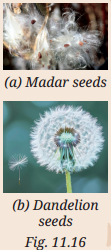
Look at the pictures (Fig.) of calotropis (madar) seeds and dandelion seeds given below. Can you guess what kind of seed dispersal these seeds are adapted for? Class 9
Answer:
Calotropis (madar) seeds and dandelion seeds are adapted for disperal by wind. These seeds are adapted for wind dispersal, as they have light, hairy structures that help them float in air.