In the example of an athlete running back and forth on a straight track. Class 9
In the example of an athlete running back and forth on a straight track. Class 9
Pause and Ponder (Page 51)
Question 1.
In the example of an athlete running back and forth on a straight track (Fig.), when will the displacement of the athlete be zero? What will be the total distance travelled in that case? Class 9
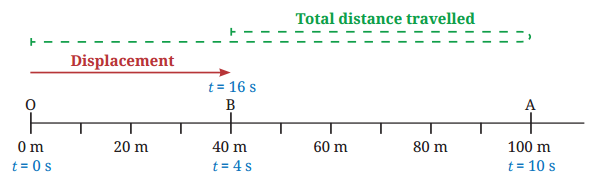
Fig. Reference point and positions of athlete at different instants of time
Answer:
The displacement of the athlete will be zero when the athlete returns to the same position from which they started, i.e., back to the origin O. This is because displacement is the net change in position between the starting and stopping points. If the athlete starts at O and returns to O, the net change in position is zero, so displacement = zero.
In that case, the total distance travelled will NOT be zero - it will be the sum of all the paths covered by the athlete. For example, in Fig., if the athlete goes from O to A (100 m) and then comes back all the way to O, the total distance = 100 m + 100 m = 200 m, but displacement = 0 m. So displacement is zero but total distance travelled is 200 m (or more, depending on how far the athlete went).