In the lower Himalayan region of northern India, apples are an important cash crop. Class 9
In the lower Himalayan region of northern India, apples are an important cash crop. Class 9
Question 1.
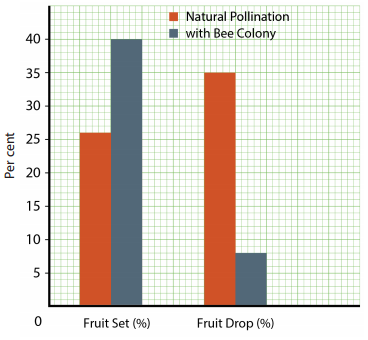
In the lower Himalayan region of northern India, apples are an important cash crop that contribute significantly to farmer’s livelihoods. The fruit yield in apple cultivation is declining continuously, associated with climate change and a significant decline in the population of natural pollinators. A researcher-farmer group set up two experimental apple orchards at two distinct locations: Places A and B. In apple orchards at Place A, they allowed natural pollinators to pollinate the flowers of the apple. In apple orchards at Place B, they applied mixed farming techniques of beekeeping. Along with honey, the farmer yielded apples. The yield of apples is depicted in Fig., in terms of fruit setting (number of fruits/the total number of corresponding fruit-bearing branches) and fruit drop (premature falling of developing fruits) in the two types of experimental places of apple orchards. Class 9
(i) What are the hypotheses the researcher farmers group has thought of for this investigation?
(ii) What are the different parameters in the experiment?
(iii) Compare and analyse the data of two experimental orchards Places A and B, in terms of high yields of apple fruits.
(iv) Based on your analysis, what do you infer from the data?
Answer:
(i) Using bee colonies for pollination (mixed farming with beekeeping) increases the fruit setting percentage in apple orchards compared to natural pollination alone. Using bee colonies for pollination reduces fruit drop percentage compared to natural pollination alone. Managed pollination by bee colonies leads to higher apple yields than relying only on natural pollinators.
(ii) Independent variable: Pollination method (natural pollination at Place A vs. mixed farming with bee colony at Place B). Dependent variables: Fruit setting percentage (number of fruits formed per total number of fruit-bearing branches) and fruit drop percentage (premature falling of developing fruits).
Controlled variables: Apple variety, geographical conditions of the two locations (must be similar), farming practices other than pollination, irrigation, pesticide use, etc.
(iii) The graph shows that the fruit setting percentage at Place B (with bee colony) is significantly higher (approximately 35%) compared to Place A (natural pollination, approximately 2 5%). The fruit drop percentage at Place B (with bee colony) is significantly lower (approximately 8%) compared to Place A (natural pollination, approximately 30%). This indicates that managed bee pollination results in both more fruits being set and fewer fruits dropping prematurely.
(iv) The data strongly suggests that managed bee pollination (mixed farming with beekeeping) is significantly more effective than relying solely on natural pollinators for high-yield apple cultivation. The higher fruit setting and lower fruit drop in Place B indicate that bee colonies ensure better and more efficient pollination of apple flowers. As natural pollinator populations decline due to climate change, introducing bee colonies can help compensate and maintain or improve fruit yields. This supports the practice of integrating beekeeping with apple farming in the lower Himalayan region.