Let Us Enhance Our Learning (Pages 186) In Fig. 12.17, how many hours of sunlight do the North Pole and the South Class 7
hardLet Us Enhance Our Learning (Pages 186) In Fig. 12.17, how many hours of sunlight do the North Pole and the South Class 7
Let Us Enhance Our Learning (Pages 186) Class 7
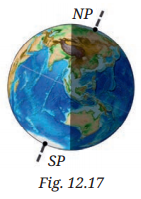
In Fig. 12.17, how many hours of sunlight do the North Pole and the South Pole receive during one rotation of the Earth?
Answer:
In Fig. 12.17, South Pole receive 24 hours sunlight (day) and the North Pole receive 24 hours no sunlight (night).
Fill in the blanks
(i) Stars rise in the ............ and set in the .............
Answer:
East, West
(ii) Day and night are caused by the Earth's .............
Answer:
rotation
(iii) When the Moon fully covers the Sun from our view, it is called a........... solar eclipse.
Answer:
total
State whether True or False
(i) Lunar eclipse occurs when the Sun comes between the Earth and the Moon.
Answer:
False. (A lunar eclipse happens when the Earth is in between the Sun and the Moon. This causes the Earth's shadow to fall on the moon, blocking the Sun's light.
(ii) Sunrise happens earlier in Gujarat than in Jharkhand.
Answer:
False. (Jharkhand is located to the East of Gujarat. Sun rises in the East. So, Sun rises earlier in Jharkhand)
(iii) In Chennai, the longest day occurs on the summer solstice.
Answer:
True. (The longest day of the year happens on June 21st (the summer solstice). Chennai, being in the Northern Hemisphere, experiences its longest day during this time.
(iv) We should watch the solar eclipse directly with our naked eye.
Answer:
False. (Because looking at a solar eclipse directly damage your eyes).
(v) Seasons occur due to the tilt of Earth's axis of rotation and its spherical shape.
Answer:
True. (The tilt of the Earth's axis and its spherical shape cause the Sun's rays to hit different parts of the Earth at different angles throughout the year, creating the seasons)
(vi) The Earth's revolution around the Sun causes day and night.
Answer:
False. (Day and night are caused by the Earth's rotation on its axis)