Sohan designed an experiment for the regeneration of sugarcane. Class 9
Sohan designed an experiment for the regeneration of sugarcane. Class 9
Question 1.
Sohan designed an experiment for the regeneration of sugarcane, where be used cuttings to grow sugarcane. He used two types of cuttings, type ‘A’ and type ‘B’ (Fig.). After a few weeks, type ‘B’ cuttings sprouted and developed into sugarcane plants, whereas the type ‘A’ cuttings did not sprout. Class 9
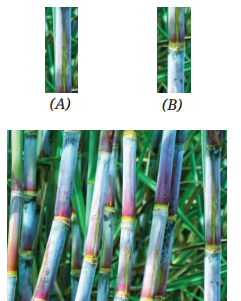
(i) Why were the type ‘B’ cuttings able to grow as sugarcane but type ‘A' could not?
Answer:
Type 'B' cuttings were able to grow because they contained nodes - the regions of the stem that have intercalary meristem. Intercalary meristem is present at the base of internodes or just above nodes. This meristematie tissue can actively divide and give rise to new shoots. Type 'A' cuttings likely did not contain nodes, so they lacked meristematie tissue and had no ability to regenerate new growth.
(ii) What difference was present in type ‘B’ compared to type ‘A’?
Answer:
The difference in type 'B' compared to type 'A' was the presence of nodes (which contain meristematic/intercalary meristem tissue). Type 'B' cuttings had at least one node that could give rise to new buds and eventually develop into a full plant. Type 'A' cuttings may have only had internodal sections without any node.
(iii) What observation or measurement was made to determine whether this change had an effect?
Answer:
The observation made was whether the cuttings sprouted (produced new buds or shoots) and eventually developed into complete sugarcane plants. Measurement of the length/ growth of new shoots over a few weeks was likely recorded to confirm the effect.
(iv) What parameters should be kept the same for both types of cuttings to ensure a fair comparison?
Answer:
To ensure a fair comparison, the following parameters should be kept the same for both types of cuttings:
- Same species of sugarcane
- Same length and size of cuttings
- Same soil type and pot/container
- Same amount of water given
- Same sunlight exposure
- Same temperature and environmental conditions
- Same time period of observation
- Same number of cuttings for each type (replication)