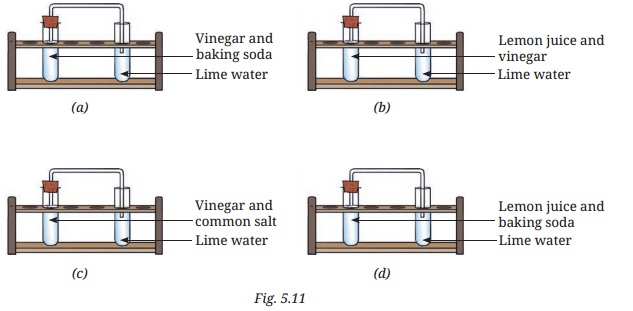
The experiments shown in Fig. 5.11a, b, c, and d were performed. Find out in which case(s) did lime water Class 7
hard
R
RBSEGuide
Expert Answer
The experiments shown in Fig. 5.11a, b, c, and d were performed. Find out in which case(s) did lime water Class 7
The experiments shown in Fig. 5.11a, b, c, and d were performed. Find out in which case(s) did lime water turn milky and why? Class 7
Answer:
- In figure (a), the vinegar (acetic acid) reacts with baking soda and carbon dioxide gas will be produced. This carbon dioxide gas reacts with lime water, to form calcium carbonate, that turns the lime water milky.
- In figure (b), lemon juice and vinegar, both are acids, so they will not produce carbon dioxide and the lime water will not turn milky.
- In figure (c), the common salt will not react with vinegar and no carbon dioxide will be produced. Therefore, lime water will not turn milky.
- In figure (d), the lemon juice will react with baking soda and carbon dioxide will be produced, that will turn the lime water milky.
- Vinegar or lemon juice + Baking soda → Carbon dioxide + other substances.