The potential energy-displacement graph of a 0.5 kg ball moving along a frictionless. Class 9
R
RBSEGuide
The potential energy-displacement graph of a 0.5 kg ball moving along a frictionless. Class 9
Question 1.
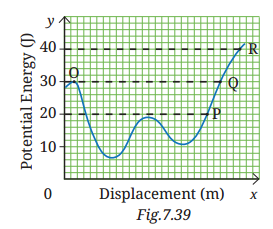
The potential energy-displacement graph of a 0.5 kg ball moving along a frictionless track is shown in Fig. At O, the velocity of the ball is 0 m s-1 and potential energy is 30 J. Calculate the velocity of the ball at P, Q and R.
Answer:
Total mechanical energy (conserved on frictionless track) = KE at O + PE at O = 0 + 30 = 30 J.
From Fig. 7.39: PE at P = 20 J; PE at Q = 30 J; PE at R = 40 J.
- At P: KE = 30 - 20 = 10 J. 1/2 × 0.5 × v² = 10 → v² = 40 → v = [latex]\sqrt {40}[/latex] ≈ 6.32 m s-1.
- At Q: KE = 30 - 30 = 0 J. v = 0 m s-1. (Ball momentarily stops - a turning point.)
- At R: PE = 40 J > Total ME = 30 J.
Since PE > Total ME, KE would need to be negative - which is impossible. Therefore, the ball cannot reach R. It turns back before reaching R.