Two blocks P and Q on a smooth horizontal surface are shown in Fig. (a) and (b). Class 9
Two blocks P and Q on a smooth horizontal surface are shown in Fig. (a) and (b). Class 9
Question 1.
Two blocks P and Q on a smooth horizontal surface are shown in Fig. (a) and (b). Two forces of magnitudes 4 N and 5 N are acting in opposite directions on block P, while block Q is moving with a constant velocity. Class 9
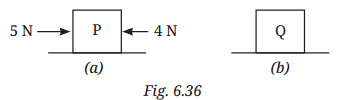
Which of the following statements is correct?
(i) P experiences a net force and Q does not experience a net force.
(ii) P does not experience a net force and Q experiences a net force.
(iii) Both P and Q experience a net force.
(iv) Neither P nor Q experiences a net force.
Answer:
(i) P experiences a net force and Q does not experience a net force.
For Block P: Forces 5 N and 4 N act in opposite directions. Net force = 5 - 4 = 1 N. P experiences a net force.
For Block Q: It is moving with constant velocity. By Newton's first law, constant velocity means zero acceleration, which means zero net force.
Question 2.
While practising for the snake boat race (Vallum kalli in Kerala), 100 oarsmen are rowing a boat together. Out of these, 95 row backwards to propel the boat forward. But by mistake, 5 oarsmen row in the opposite direction. If each oarsman applies a horizontal force of 200 N, what is the net force on the snake boat? (Ignore drag forces, air friction, etc.) Class 9
Answer:
Force by 95 oarsmen (forward) = 95 × 200 = 19,000 N
Force by 5 oarsmen (backward) = 5 × 200 = 1,000 N
Net force = 19,000 - 1,000 = 18,000 N in the forward direction.