When the pole of a bar magnet is brought close to a magnetic compass. Class 9
When the pole of a bar magnet is brought close to a magnetic compass. Class 9
Question 1.
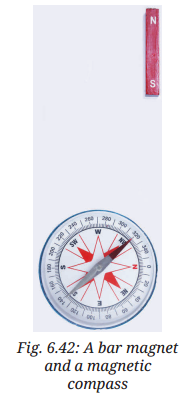
When the pole of a bar magnet is brought close to a magnetic compass, the bar magnet and the compass needle (which is also a magnet) exert a magnetic force on each other. As per Newton's third law of motion, both the forces are equal in magnitude and opposite in direction. However, the compass needle moves, whereas the bar magnet does not move (Fig.). Explain why. Class 9
Answer:
Both the compass needle and the bar magnet experience equal and opposite forces (Newton's third law). However, their masses are very different. The bar magnet is much heavier (larger mass) than the compass needle.
By Newton's second law: a = [latex]\frac{\mathrm{F}}{\mathrm{~m}}[/latex]. For the same force F, the compass needle (very small mass) experiences a very large acceleration and moves noticeably. The bar magnet (large mass) experiences a very small acceleration - too small to be observed.
This is why only the compass needle appears to move, while the bar magnet does not.