Why are the epithelial tissues that line an animal’s internal organs. Class 9
Why are the epithelial tissues that line an animal’s internal organs. Class 9
Question 1.
Why are the epithelial tissues that line an animal’s internal organs usually only one or a few cells thick? Class 9
(i) To store food efficiently.
(ii) To provide maximum strength.
(iii) To allow quick exchange of materials across them.
(iv) To reduce friction.
Answer:
(iii) To allow quick exchange of materials across them.
Internal organs like the lungs, blood vessels and intestine require rapid exchange of gases, nutrients and other materials between the organ and the blood. Being only one or a few cells thick minimises the distance materials have to travel, enabling quick and efficient diffusion. A thick layer would slow down this exchange greatly.
Question 2.
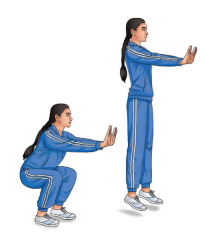
You can perform these two jumps (Fig.): Straight-leg jump — keep knees and ankles stiff. Normal jump —bend knees and ankles naturally. How did your ankle, knee and hip positions differ between the two jumps?
Answer:
In the straight leg jump, the knees and ankles are kept stiff, so only the hip joint is used for the jumping motion. Landing is very hard, painful and causes greater impact on the body because the joints cannot absorb shock.
In the normal jump, the knees and ankles bend naturally. During takeoff and landing, the knee and ankle joints act as shock absorbers- cartilage at joints cushions the impact. The hip joint also participates in bending. This makes the jump smoother, more efficient and reduces stress on the bones and joints. The normal jump demonstrates why joints and cartilage are so important for movement and protection.