You are given a mixture of sand, common salt and naphthalene. Class 9
You are given a mixture of sand, common salt and naphthalene. Class 9
Question 1.
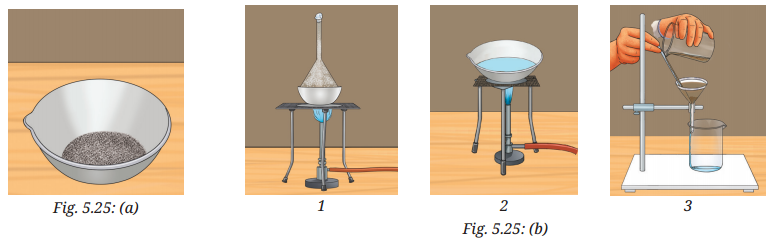
You are given a mixture of sand, common salt and naphthalene [Fig. (a)]. The Fig. (b) depicts various steps used to separate the components of this mixture. Identify and write down the correct sequence of separation techniques.
Answer:
The correct sequence of separation techniques is:
Step 1 - Sublimation: Heat the mixture gently. Naphthalene sublimes (converts directly to vapour) and is collected on the cooler funnel, leaving behind sand and salt.
Step 2 - Dissolve in water and Filter: Add water to the remaining mixture of sand and salt. Salt dissolves in water (filtrate), while sand does not dissolve and is collected on the filter paper as residue.
Step 3 - Evaporation/Distillation: Evaporate the filtrate (salt solution) to recover common salt. All three components - naphthalene, sand, and common salt - are now separated.
Question 2.
Why is distillation an effective method for separating a mixture of water and acetone? Class 9
Answer:
Distillation is effective for separating water and acetone because:
- Water and acetone are miscible liquids (they mix completely), so simple filtration or a separating funnel cannot separate them.
- They have significantly different boiling points - acetone boils at 56°C and water boils at 100°C. The difference is 44°C, which is well above the required minimum of 25°C for distillation to work effectively.
- When the mixture is heated, acetone vaporises first at 56°C, the vapour is condensed and collected as pure acetone. Water remains behind in the distillation flask.